

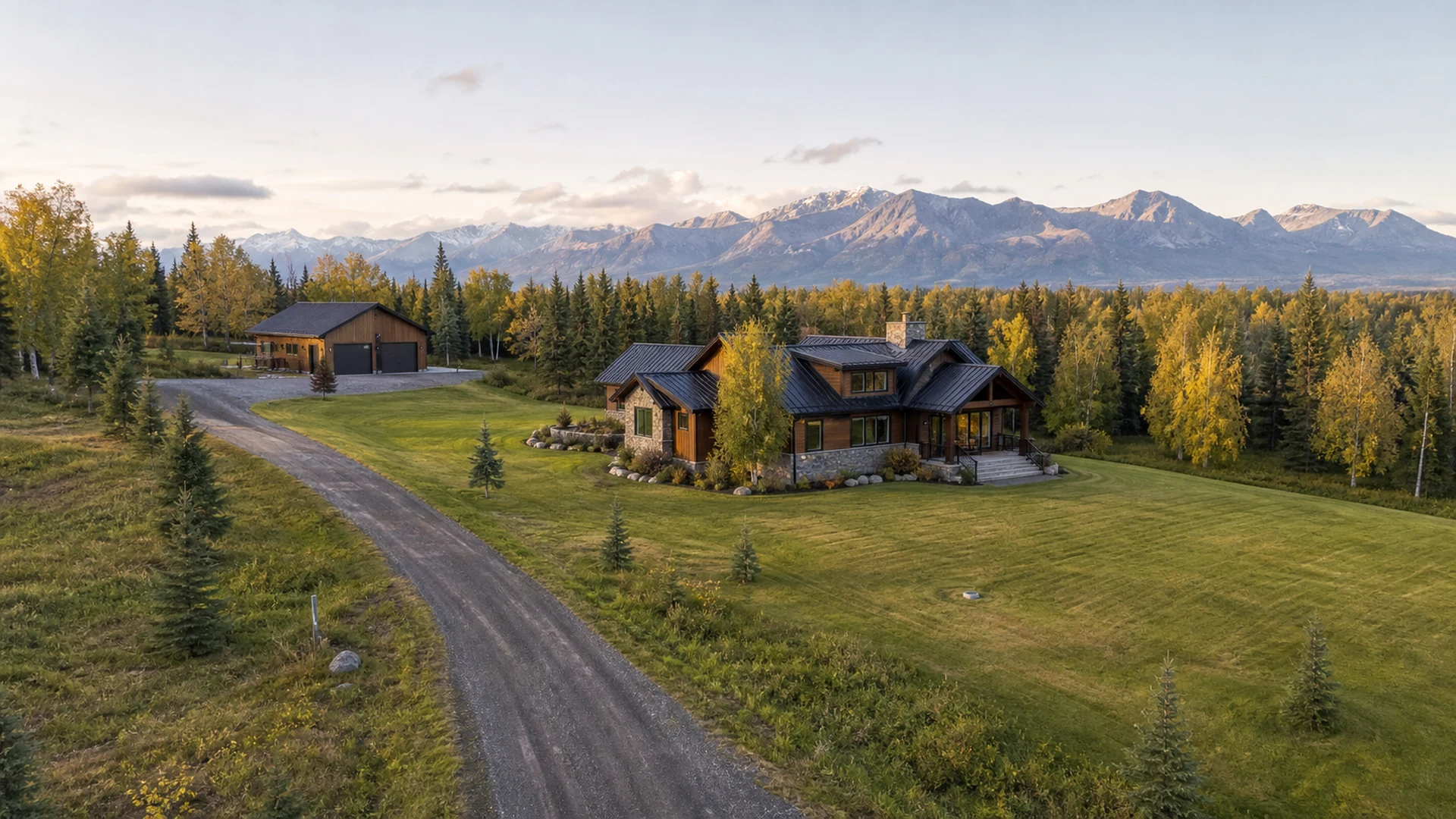
The largest residential lots near Anchorage sit on the upper Hillside, throughout Chugiak-Eagle River, in and above Girdwood, and across the neighboring Matanuska-Susitna Borough — because true acreage is scarce inside the Anchorage Bowl, where urban districts are built around smaller, serviced lots. Most acreage homes rely on a private well and an on-site septic system rather than piped municipal utilities. In the Municipality of Anchorage, new or upgraded wells and septic systems require a permit from the Development Services On-Site Water and Wastewater Section, and statewide these systems are regulated under Alaska DEC's 18 AAC 72. The most important acreage questions are almost never about the house — they are about the land: buildable area, road access and winter maintenance, water and wastewater, and the parcel's zoning or lack of it.
After four decades living in Anchorage, I've watched what buyers actually mean when they say they want “acreage.” Sometimes it's genuine room to spread out; sometimes it's privacy, a view corridor, or space for shops, animals, or equipment. What almost every acreage buyer underestimates is that the value and the headaches both live in the dirt, not the drywall. A beautiful custom home on a parcel that can't perc, sits on an unmaintained private road, or straddles wetlands is a very different purchase than the same home on clean, buildable, serviced land.
This page is the local orientation I give acreage buyers before we tour anything: where the large lots actually are around Anchorage, how well and septic due diligence works here, how zoning differs across the Municipality of Anchorage and the Mat-Su Borough, and the short list of things to verify before an offer. It's written to be useful whether or not you ever call me.
- True acreage is scarce inside the Anchorage Bowl; the large lots are on the upper Hillside, in Chugiak-Eagle River, around Girdwood, and across the Mat-Su Borough.
- Most acreage homes run on a private well and an on-site septic system, not piped utilities.
- In the Municipality of Anchorage, new or upgraded wells and septic for a single-family or duplex home need a permit from the On-Site Water and Wastewater Section, and septic designs must come from a registered civil engineer.
- Alaska DEC regulates on-site wastewater statewide under 18 AAC 72 and keeps system records in its EDMS database; the Municipality of Anchorage maintains its own single-family/duplex septic records.
- Chugiak-Eagle River has its own land-use chapter (Anchorage Municipal Code Title 21, Chapter 21.10) with large-lot and rural districts; the Mat-Su Borough has no borough-wide zoning and no residential building codes.
- On raw land, make the purchase contingent on a satisfactory percolation (perc) test — some lots only support a holding tank or advanced system.
- Even on a plowed public road, the owner still clears driveway and mailbox berms; confirm who maintains the road before you buy.
Where Can You Find Homes With Acreage Near Anchorage?
Buyers touring the Anchorage Bowl for large lots almost always run into the same wall: the urban districts are simply not built for it. The Bowl's residential zoning is organized around smaller, fully serviced lots, so acreage inside the city is rare and priced accordingly. The room opens up as you move to the edges of the corridor.
On the upper Hillside, south and east of the city, you find larger view parcels that transition into the foothills of the Chugach — many on well and septic rather than piped utilities. In Chugiak-Eagle River, the land-use pattern is fundamentally different from the Bowl: the area's own comprehensive plan describes many neighborhoods as larger-lot areas shaped by limited public infrastructure and a lower-density development pattern. That's not an accident — the Municipality wrote a separate zoning chapter (Title 21, Chapter 21.10) specifically to preserve the area's rural character. Girdwood and the upper Turnagain Arm corridor offer mountain acreage in a narrow, dramatic valley. And across the boundary into the Matanuska-Susitna Borough, parcels get larger and cheaper per acre the farther out you go — often advertised as unrestricted, with no HOA and no zoning.
“Acreage” near Anchorage does not automatically mean remote. Parts of Chugiak-Eagle River feel suburban, especially near the Eagle River core and where public water and sewer reach, while a similar-sized parcel in Willow or Trapper Creek can be genuinely off-grid. Judge each property on its own access and services, not on the acreage number.
| Area | Land character | Typical utilities | Zoning framework |
|---|---|---|---|
| Anchorage Bowl | Smaller serviced lots; little true acreage | Piped municipal water & sewer | Anchorage Municipal Code Title 21 (urban districts) |
| Upper Hillside | Larger view parcels into Chugach foothills | Well & septic common | Title 21 (Anchorage Bowl zoning) |
| Chugiak-Eagle River | Large-lot, lower-density, rural | Mixed public and private | Title 21, Chapter 21.10 (own chapter) |
| Mat-Su Borough | Largest, cheapest per acre, sometimes off-grid | Private well & septic; off-grid possible | No borough-wide zoning; no residential building codes |
Do Acreage Homes Near Anchorage Use a Well and Septic System?
In most cases, yes. Once you leave the areas served by piped municipal water and sewer, an acreage home draws its drinking water from a private well and disposes of wastewater through an on-site septic system. Unlike a Bowl property where those services arrive at the property line, an acreage buyer is buying the responsibility for two pieces of infrastructure that most Lower-48 buyers never think about.
Two layers of rules apply. Statewide, all on-site wastewater systems fall under Alaska DEC's regulations in 18 AAC 72, which set who may design and install a system and the process for approval; DEC recommends a registered professional engineer oversee the design and only certified installers (or an approved homeowner) do the work. On top of that, the Municipality of Anchorage — and the City of Valdez — has additional local requirements. Per the Municipality, new construction or an upgrade to a septic system for a single-family or duplex home requires a permit, and the design, with soils and site information, must be submitted to the On-Site Water and Wastewater Section by a registered civil engineer. A new well requires its own permit as well.
Separation distances quietly shape what a lot can do. DEC's manual references minimum separation distances between a septic system and any well within 200 feet, and general guidance points to roughly 100 feet from a drinking-water well to a drainfield. On a smaller or oddly shaped parcel, those setbacks — not the acreage total — can be what limits where a system fits.
What Should You Check on a Well-and-Septic Acreage Property?
The well-and-septic surprise that catches acreage buyers most often is the record — or the missing record. A careful local pulls the system history before the offer, not after. Alaska DEC maintains on-site wastewater records in its EDMS database, and the Municipality of Anchorage and Valdez keep their own single-family and duplex septic records separately, which EDMS does not duplicate. Start there.
What to verify (existing home)
- Septic tank age, size, and location
- Prior DEC or MOA certifications and any waivers
- Required separation distances to well and property lines
- Well records and who's responsible for water testing
- Maintenance/pumping history (systems can last 25–40+ years, or fail early if neglected)
What to verify (raw land)
- Percolation (perc) test result — make it a contingency
- Soils and buildable area, not just total acreage
- Whether a standard system is feasible or only a holding tank
- Road access and legal access (easement vs. maintained road)
- Wetlands, drainage, and utility availability
On raw land especially, the perc test is the pivot point. It determines how quickly water drains through the soil, which dictates what system DEC will approve — or whether a conventional system is feasible at all. Some parcels fail perc testing entirely, leaving a holding tank or an advanced treatment unit as the only options. That is exactly why an acreage land purchase should be made contingent on a satisfactory perc result. An older steel septic tank — say, one installed more than 15 years ago — is also worth inspecting for corrosion, as DEC itself flags.
Is There Zoning on Acreage in Chugiak, Eagle River, and Mat-Su?
This is where the two big acreage regions diverge sharply, and it matters for what you can build and how neighbors can develop around you.
Chugiak-Eagle River: rural character, written into the code
Chugiak-Eagle River is part of the Municipality of Anchorage but has its own zoning chapter — Title 21, Chapter 21.10 — adopted to preserve the area's distinctive rural character and unique lifestyle while planning for growth. It includes large-lot single-family and lower-density residential districts, plus rural and transition districts for areas not expected to develop along tight land-use lines in the near term. The practical takeaway: this is a genuinely different land-use pattern from the Anchorage Bowl, and lot-size minimums and allowed uses vary by district. Because those minimums differ district by district, verify the specific parcel's zoning with the Municipality's Land Use Review Section rather than relying on a listing description.
Mat-Su Borough: freedom, and the responsibility that comes with it
The Matanuska-Susitna Borough is the opposite model. It has no borough-wide zoning, and borough officials have stated publicly that there are no residential building codes; the borough's land-use ordinances focus on impacts such as effects on neighboring properties and water quality, not on fire, electrical, or plumbing safety. That's why so many Mat-Su parcels are marketed as “unrestricted” with no HOA. For a buyer who wants to build a shop, keep animals, or design without a design committee, that freedom is a real advantage. The flip side is that the safety and buildability burden shifts to you — which is exactly what MLS listings signal when they instruct the buyer to verify zoning, utilities, access, setbacks, wetlands, soils, and well/septic feasibility.
Zoning, code, and lot-size rules change and vary parcel by parcel. This page is general and educational, not legal advice. Confirm any specific parcel's requirements with the Municipality of Anchorage or the Matanuska-Susitna Borough before you rely on them.
What Does Acreage Add in Winter — and to Ongoing Cost?
Owning land in Southcentral Alaska is a year-round commitment, and winter is where the difference between a city lot and acreage shows up. Even on a publicly plowed road, the owner is still responsible for clearing the snow berm at the driveway and mailbox — and a long driveway or multiple access points is a much bigger job than a compact urban lot. Side streets and rural roads are frequently cleared later than main routes. Confirm who actually maintains the road: a municipal or road service area, the state DOT&PF, or the owner via a private easement. That single answer can change the true cost of a property more than the price per acre does.
There's an ongoing-cost layer, too. A septic system typically needs pumping every three to five years for a normal household, more often for larger homes or holding tanks, and pumping in Alaska commonly runs a few hundred dollars per visit depending on access and tank size. A private well makes the owner responsible for water sampling and testing. None of this is a reason to avoid acreage — it's simply the real budget that comes with the space.
How Acreage Affects Selling — and Disclosure
If you already own acreage and are thinking of selling, two things drive your outcome. First, value here is about usable acreage — cleared, buildable, accessible, and serviced land shows and sells better than raw acreage of the same size, and my design background is genuinely useful in staging the home and presenting the land so a buyer sees the potential rather than the project. Second, Alaska's disclosure regime is strict: under AS 34.70, a seller of residential real property must deliver a completed written disclosure statement before the buyer makes a written offer, and the form even asks sellers to estimate monthly utility costs — gas, electric, oil, propane, wood, water, sewer, and refuse. Willful violations expose a seller to up to three times the buyer's actual damages, so an acreage seller's well, septic, water-testing, and access history should be documented honestly and early. If you'd like a specific read on your parcel, get your Anchorage home value.
- Municipality of Anchorage — Development Services, On-Site Water & Wastewater Section: well & septic permit requirements; engineer-prepared designs; separation-distance waivers (muni.org).
- Alaska Dept. of Environmental Conservation — 18 AAC 72 on-site wastewater regulations; EDMS records database; buying-a-home and installation guidance (dec.alaska.gov).
- Municipality of Anchorage — Anchorage Municipal Code, Title 21 (Land Use Planning), Chapter 21.10, Chugiak-Eagle River zoning districts and purpose.
- Matanuska-Susitna Borough — Planning & Land Use / myProperty; borough statements that Mat-Su has no borough-wide zoning and no residential building codes.
- Alaska Statutes — AS 34.70 (Disclosures in Residential Real Property Transfers), including the pre-offer delivery requirement and treble-damages exposure (akleg.gov / State of Alaska disclosure form).
Looking at Acreage Around Anchorage?
Let’s check the land before you fall for the view. I’ll help you read access, water, and zoning on any parcel you’re considering.
Frequently Asked Questions
The largest lots close to Anchorage are on the upper Hillside, throughout Chugiak-Eagle River, in and above Girdwood, and across the Matanuska-Susitna Borough. Chugiak-Eagle River has its own zoning chapter (Anchorage Municipal Code Title 21, Chapter 21.10) that includes large-lot single-family and rural districts, and the Mat-Su Borough has no borough-wide zoning and many unrestricted parcels. Inside the Anchorage Bowl, true acreage is scarce because urban districts are built around smaller serviced lots.
Most do. Outside the areas served by piped municipal water and sewer, acreage homes rely on a private well for drinking water and an on-site septic system for wastewater. In the Municipality of Anchorage, new or upgraded wells and septic systems for a single-family or duplex home require a permit from the Development Services On-Site Water and Wastewater Section, and septic designs must be prepared by a registered civil engineer. Statewide, on-site wastewater systems are regulated under Alaska DEC’s 18 AAC 72.
Pull the system records early. Alaska DEC keeps on-site wastewater records in its EDMS database, and the Municipality of Anchorage and City of Valdez maintain their own single-family and duplex septic records. Confirm the septic tank’s age, size and location, whether prior DEC or MOA certifications exist, and that required separation distances to the well and property lines are met. On raw land, make the purchase contingent on a satisfactory percolation (perc) test, because a lot that fails perc testing may only support a holding tank or advanced treatment unit.
Yes. Chugiak-Eagle River is governed by its own chapter of the Anchorage land-use code — Title 21, Chapter 21.10 — which was written to preserve the area’s rural character and includes large-lot single-family and lower-density residential districts. That is a different land-use pattern from the Anchorage Bowl, where districts such as R-1A are designed around smaller, fully serviced lots. Lot-size minimums vary by district, so verify the specific parcel’s zoning with the Municipality before you rely on any assumption.
Largely no. The Matanuska-Susitna Borough has no borough-wide zoning and, as borough officials have stated publicly, no residential building codes; its land-use ordinances focus on impacts like effects on neighboring properties and water quality rather than fire, electrical, or plumbing safety. Many Mat-Su parcels are advertised as unrestricted with no HOA. That freedom is a genuine draw, but it also means a buyer carries more of the due-diligence burden — verifying access, utilities, wetlands, soils, and buildability directly.
Land near Anchorage generally costs more per acre the closer it is to the city and the more usable and serviced it is. A cleared, buildable, road-accessible view parcel on the Hillside commands a premium, while remote, trail-only, or wet acreage in the Mat-Su can be far cheaper per acre. Because usable-acre value varies so widely, compare properties on buildable area, access, and utilities — not raw lot size alone.
Even on a publicly plowed road, an acreage owner is still responsible for clearing the snow berm at the driveway and mailbox, and a long driveway or multiple access points is meaningfully more work than a compact city lot. Side streets and rural roads are often cleared later than main routes. Confirm who maintains the road — a municipal service area, a road service area, the state DOT&PF, or the owner via a private easement — before you buy.