

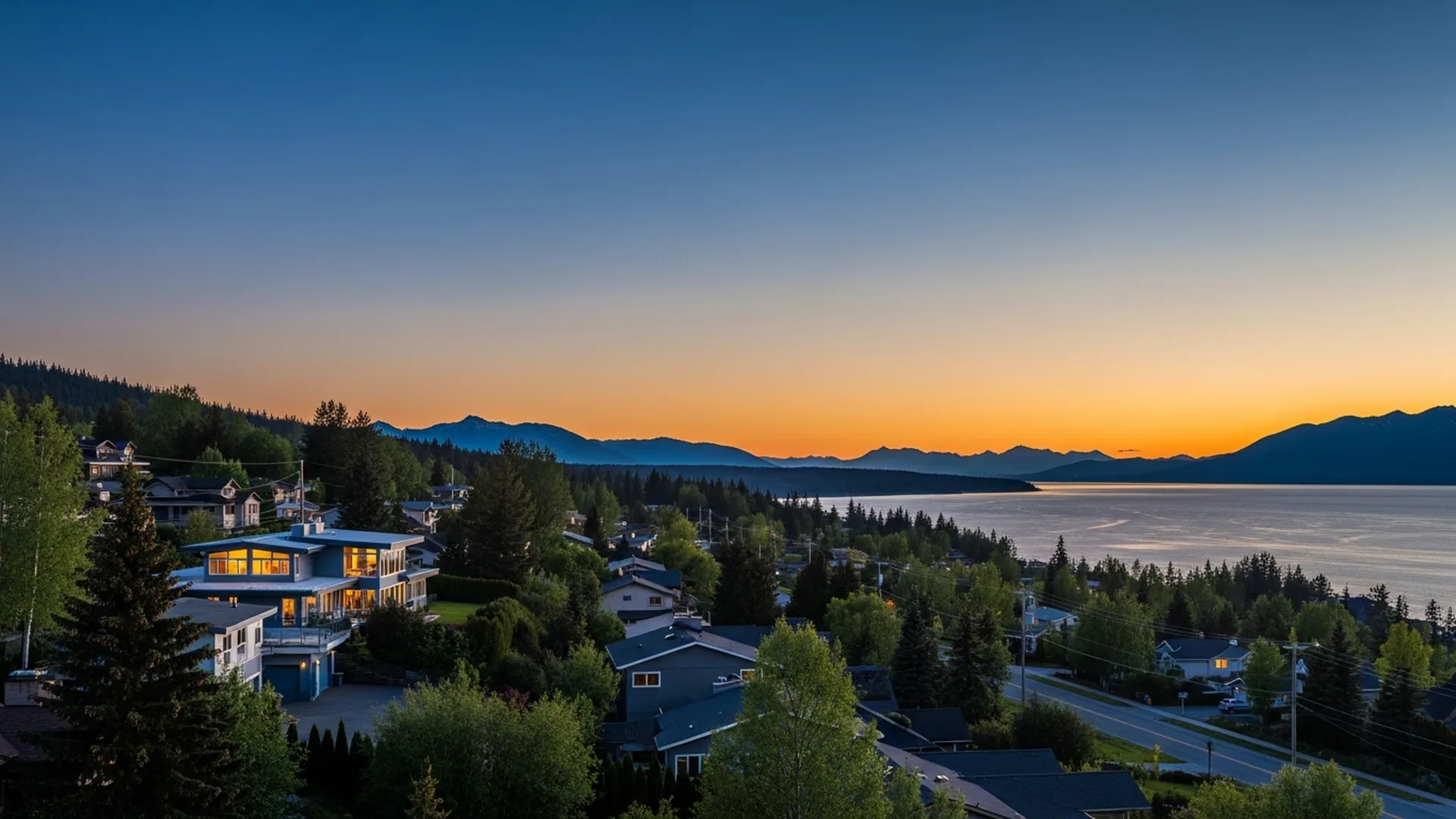
Turnagain is a coastal neighborhood in West Anchorage, bounded by Cook Inlet, Lake Hood and Fish Creek, and Minnesota Drive, sitting about four miles from downtown along the Tony Knowles Coastal Trail. It is one of Anchorage’s older established neighborhoods, best known for its coastline, its west-facing Cook Inlet views toward Mount Susitna and Denali, and its proximity to Lake Hood, the world’s busiest seaplane base. Because the neighborhood sits on coastal bluffs underlain by the Bootlegger Cove Clay — the formation that failed in the 1964 earthquake at what is now Earthquake Park — the Municipality of Anchorage maps seismic ground-failure hazard zones and requires geotechnical review for new subdivisions in the highest-hazard zones. For luxury buyers, Turnagain trades new construction for location: coastal frontage, mature trees, and floatplane access on an established grid, where the lot and the view often matter more than the house.
When people picture “coastal Anchorage,” they are usually picturing Turnagain without knowing its name. It is the stretch of the city where the paved Coastal Trail hugs the water, where the sunset lights up Cook Inlet, and where floatplanes climb out over the rooftops from Lake Hood. In four decades of watching this city grow, I’ve found Turnagain is one of the neighborhoods buyers most consistently misread — they arrive expecting a glossy new subdivision and instead find an established, tree-shaded grid where the real value is in the location and the land underneath the house.
This guide covers what actually defines the neighborhood: where it sits, why its housing stock is different from newer parts of town, how the views work, the floatplane story at Lake Hood, and the one piece of due diligence — seismic ground conditions — that matters more here than almost anywhere else in Anchorage. First, a name clarification worth making up front: the Turnagain neighborhood in West Anchorage is a different place from Turnagain Arm, the tidal waterway southeast of the city near Girdwood. This page is about the neighborhood.
- Turnagain is a West Anchorage neighborhood bounded by Cook Inlet, Lake Hood and Fish Creek, and Minnesota Drive, about four miles from downtown.
- It is one of Anchorage’s older established neighborhoods; before 1964 the bluff section (Turnagain Heights) held many of the city’s finer homes.
- The signature view is west/northwest across Cook Inlet toward Mount Susitna, Fire Island, and Denali — the same direction as the sunset.
- The neighborhood has direct access to the 11-mile Tony Knowles Coastal Trail via Earthquake Park, Lyn Ary Park, and Point Woronzof.
- It borders Lake Hood, the world’s busiest seaplane base, averaging roughly 190 flights per day — making floatplane lots a rare, durable niche.
- Turnagain sits on coastal bluffs underlain by the Bootlegger Cove Clay, the formation that failed in the 1964 quake; the Municipality maps seismic ground-failure hazard zones here.
- Under Anchorage Title 21, a geotechnical investigation is required for subdivisions within seismic Zones 4 and 5 — a real consideration for bluff-side parcels.
Where Is the Turnagain Neighborhood in Anchorage?
Turnagain occupies the coastal corner of West Anchorage. Local neighborhood references and the Municipality’s West Anchorage District Plan describe it as bounded by Cook Inlet to the north and west, Lake Hood and Fish Creek to the south, and Minnesota Drive to the east, with downtown Anchorage roughly four miles away. Unlike the sprawling half-acre-and-up lots you find on the Hillside or in Eagle River, Turnagain is a compact, walkable grid of established residential streets with, as the district plan puts it, little to no commercial business woven through it.
That layout is part of the appeal. Buyers who tour Turnagain after looking at newer subdivisions consistently notice the difference: mature trees, a settled street pattern, and coastline within walking distance rather than a fresh cul-de-sac carved out of the woods. The Municipality’s West Anchorage District Plan itself notes that Turnagain is one of Anchorage’s older neighborhoods, best known for its coastline and Coastal Trail and for the impact it sustained in the 1964 earthquake — and that it contains the school now known as West High, described in that plan as the city’s first secondary school.
| Edge / Feature | What’s There |
|---|---|
| North & West | Cook Inlet / Knik Arm; west-facing views to Mt. Susitna, Fire Island, Denali |
| South | Lake Hood & Lake Spenard (world’s busiest seaplane base); Fish Creek; Ted Stevens Airport beyond |
| East | Minnesota Drive; downtown Anchorage ~4 miles further |
| Along the coast | Tony Knowles Coastal Trail (11 mi), with access at Point Woronzof, Earthquake Park, Lyn Ary Park |
Why Are Turnagain Homes Considered Older Prestige Housing?
Turnagain’s status is historical as much as current. According to the USGS, the coastal-bluff section known as Turnagain Heights “reduced to rubble many of the finer homes of the city of Anchorage” in the 1964 landslide — a plain statement that this was, in the early 1960s, where prestige housing sat. The neighborhood that rebuilt and grew around that scar kept the location advantages that made it desirable in the first place: coastline, proximity to downtown, and now the Coastal Trail.
What that means for a buyer today is specific. Turnagain is largely built out, so the inventory skews toward mid-century and later homes rather than new construction. The value proposition is the lot and the setting, not a builder-fresh spec house. Some genuinely luxury homes exist here — particularly renovated or custom-rebuilt properties on view lots — but they are the exception on an established street, not the rule. My honest read for high-end buyers: come to Turnagain for the address and the view, and budget realistically for updates, because condition varies dramatically house to house and the “designer’s eye” on finishes and flow earns its keep in a neighborhood this age.
What Are the Views Like From Homes in Turnagain?
The defining Turnagain view faces west and northwest across Cook Inlet and Knik Arm. Local trail and parks sources consistently describe the same panorama from this coastline: Mount Susitna — the “Sleeping Lady” — Fire Island, and, on clear days, Denali and Mount Foraker on the horizon. Because that is also the direction of the sunset, west-facing bluff and near-coastal parcels command the strongest premium. Point Woronzof, at the neighborhood’s western tip, is described by Anchorage Parks & Recreation staff as “the sunset spot in town.”
A practical note the view sheets never mention: this is a coastal, forested corridor where the Coastal Trail is genuinely wild in stretches. Moose, bald eagles, and belugas near Point Woronzof are routine sightings, per Visit Anchorage and trail organizations. That’s an amenity and a caution at once — part of what makes living here feel like Alaska four miles from a downtown high-rise.
Can You Own a Floatplane Home Near Turnagain?
This is Turnagain’s rarest niche. The neighborhood borders Lake Hood, which the FAA-facility record and multiple aviation sources confirm is the world’s busiest seaplane base, handling an average of about 190 flights per day, with roughly 800–1,000 aircraft based on the connected Lake Hood and Lake Spenard. In winter, the state maintains the frozen surface as plowed ice runways for ski-equipped aircraft — so it operates year-round.
For a buyer, that translates into a small, specialized market: lakefront lots with a slip or dock at Lake Hood or Lake Spenard are among the most coveted aviation properties in Alaska, and supply is genuinely tight. Unlike remote float-plane lakes elsewhere in the state, this one puts a working seaplane base inside the city, four miles from downtown. If floatplane frontage is the goal, expect to move quickly and to pay for scarcity when a slip-served property comes up.
What draws luxury buyers to Turnagain
Cook Inlet / Knik Arm coastal views to the west; direct Coastal Trail access; established, mature, walkable streets; four miles from downtown; rare Lake Hood floatplane frontage; the prestige of one of Anchorage’s oldest fine-home neighborhoods.
What to weigh carefully
Older housing stock means variable condition and update budgets; airport and floatplane operations mean aircraft noise; coastal-bluff parcels sit in mapped seismic ground-failure hazard zones; little new construction; smaller lots than the Hillside or Eagle River.
Is It Safe to Buy a Home in Turnagain After the 1964 Earthquake Landslide?
This is the single most important piece of due diligence in Turnagain, and it deserves a clear-eyed answer rather than either alarm or hand-waving. In the 1964 Good Friday earthquake, the Turnagain Heights bluff failed catastrophically. USGS records describe a landslide about a mile and a half long fronting Knik Arm; roughly 75 homes were destroyed, and the failed ground was preserved as the 134-acre Earthquake Park rather than rebuilt. Homes were not put back on the slide itself.
The underlying cause matters for buyers now. USGS attributes the Turnagain, L Street, Fourth Avenue, and Government Hill failures to slip surfaces in the Bootlegger Cove Clay, a marine silt-clay formation that can lose strength under strong, sustained shaking. The Municipality of Anchorage takes this seriously in its planning: it maps seismically-induced ground-failure hazard zones (Zone 1 lowest through Zone 5 very high), and under Anchorage’s Title 21 subdivision standards (AMC 21.08.030), a geotechnical investigation prepared by an Alaska-licensed civil engineer is required for the portion of any subdivision within seismic Zones 4 and 5. The Municipality also maintains a Geotechnical Advisory Commission and a searchable soil-boring database.
Practically: before you make an offer on a Turnagain property — especially a bluff-side or coastal lot — identify which municipal seismic ground-failure hazard zone the parcel falls in, and ask for any existing geotechnical report. This is standard, checkable homework using Municipality of Anchorage GIS and hazard maps, not a reason to avoid the neighborhood. Most of Turnagain is a stable, desirable place to live; the point is to know your specific lot.
What Recreation and Access Come With a Turnagain Address?
The Tony Knowles Coastal Trail is the headline amenity. It runs 11 paved miles from downtown Anchorage to Kincaid Park, and Turnagain sits right on it — residents pick it up at Lyn Ary Park, Earthquake Park, or Point Woronzof. It’s a year-round asset: walking, running, and biking in summer; cross-country skiing in winter, when it forms part of the Tour of Anchorage ski marathon route. On the practical side, Minnesota Drive on the eastern edge and the nearby highway network make the downtown, Midtown, and airport commutes short. As with all of Anchorage, winter road maintenance follows the Municipality’s plowing priorities, with main and collector streets cleared first.
Thinking of Selling in Turnagain? What Drives Value Here
If you own in Turnagain, your value story is different from a newer subdivision’s, and pricing it well means leaning into what’s genuinely scarce. In my experience selling into established Anchorage neighborhoods, the levers that move a Turnagain number most are, in order: view orientation (a west/northwest Cook Inlet sightline is the premium), coastal and Coastal Trail proximity, Lake Hood floatplane frontage where it exists, and the quality and recency of updates on an older home. Because so much of the stock here is mid-century and later, condition is where sellers either capture or leave money on the table — and it’s where I put a trained design eye to work, from finish selection to how a great room frames the water.
The mistake I see most: pricing off square footage alone and ignoring orientation. Two similar Turnagain houses can differ sharply in value purely by which way they face. If you’re considering selling, start with a proper, view-aware valuation rather than a portal estimate — get your Turnagain home value and we’ll build the number from what your specific lot and sightline are actually worth.
- Municipality of Anchorage — West Anchorage District Plan (neighborhood description, character, West High) and Title 21 Land Use Planning, AMC 21.08.030 (geotechnical investigation required in seismic Zones 4 & 5); MOA seismic ground-failure hazard-zone maps and Geotechnical & Materials Testing Services / Geotechnical Advisory Commission.
- U.S. Geological Survey — 1964 Alaska earthquake and the Turnagain Heights, L Street, Fourth Avenue, and Government Hill landslides in the Bootlegger Cove Clay; USGS seismic-landslide hazard mapping for Anchorage.
- FAA facility record & U.S. Fish & Wildlife Service history — Lake Hood Seaplane Base as the world’s busiest seaplane base, ~190 flights/day, winter ski operations.
- Wikipedia & Visit Anchorage / Rails-to-Trails — Tony Knowles Coastal Trail length, route, access points (Earthquake Park, Point Woronzof, Kincaid Park), and coastal view/wildlife context.
- Anchorage School District — attendance boundary finder (confirm zoned schools by address; Turnagain Elementary, Romig Middle, West Anchorage High).
- Local neighborhood boundary references for Turnagain (Cook Inlet, Lake Hood/Fish Creek, Minnesota Drive; ~4 miles from downtown).
Looking at Turnagain? Let’s Read the Lot, Not Just the Listing
Views, floatplane frontage, and seismic hazard zones all live in the details here. I’ll help you find and vet the right coastal West Anchorage home.
Frequently Asked Questions
Turnagain is a coastal neighborhood in West Anchorage, bounded by Cook Inlet to the north and west, Lake Hood and Fish Creek to the south, and Minnesota Drive to the east. It sits roughly four miles from downtown Anchorage and fronts Knik Arm along the Tony Knowles Coastal Trail. Note that the neighborhood “Turnagain” is a different place from “Turnagain Arm,” the waterway southeast of the city.
Turnagain is one of Anchorage’s older established neighborhoods, and before the 1964 earthquake the coastal-bluff section known as Turnagain Heights held many of the city’s finer homes. Today the appeal is location — coastal frontage, Coastal Trail access, and mature tree cover four miles from downtown — rather than new construction, which is scarce. Buyers are largely purchasing a location and a lot, and much of the housing stock is mid-century and later, so condition and updates vary widely.
The signature Turnagain view is west and northwest across Cook Inlet and Knik Arm toward Mount Susitna (Sleeping Lady), Fire Island, and — on clear days — Denali and the Alaska Range. Because that orientation faces the water and the sunset, west-facing bluff and near-coastal parcels carry the strongest view premium. Point Woronzof, at the neighborhood’s western edge, is widely regarded as one of Anchorage’s best sunset spots.
Turnagain borders Lake Hood, which is the world’s busiest seaplane base and handles an average of about 190 flights per day. Lakefront lots and slips at Lake Hood and Lake Spenard are among the most sought-after aviation properties in Alaska, and in winter the state maintains the frozen surface for ski-equipped aircraft. Direct floatplane frontage is limited and specialized, so availability is narrow and demand is durable.
The 1964 landslide occurred in a coastal-bluff area now preserved as Earthquake Park; homes were not rebuilt on the failed ground. The underlying issue is the Bootlegger Cove Clay formation, which can lose strength during strong shaking. The Municipality of Anchorage maps seismic ground-failure hazard zones, and under Title 21 a geotechnical investigation is required for subdivisions within Zones 4 and 5. For any Turnagain purchase, check the property’s hazard zone and ask for any geotechnical report before you make an offer.
Turnagain is part of the Anchorage School District. Students in the area are typically zoned for Turnagain Elementary, Romig Middle School, and West Anchorage High School, with West High located within the neighborhood. Because attendance boundaries change, confirm the exact zoned schools for a specific address using the Anchorage School District’s boundary finder.
Turnagain has direct access to the Tony Knowles Coastal Trail, an 11-mile paved coastal path running from downtown Anchorage to Kincaid Park. Residents can join it at Earthquake Park, Lyn Ary Park, or Point Woronzof, and it is used year-round for biking, running, and cross-country skiing. Moose, bald eagles, and — near Point Woronzof — beluga whales are commonly seen along the coast.