

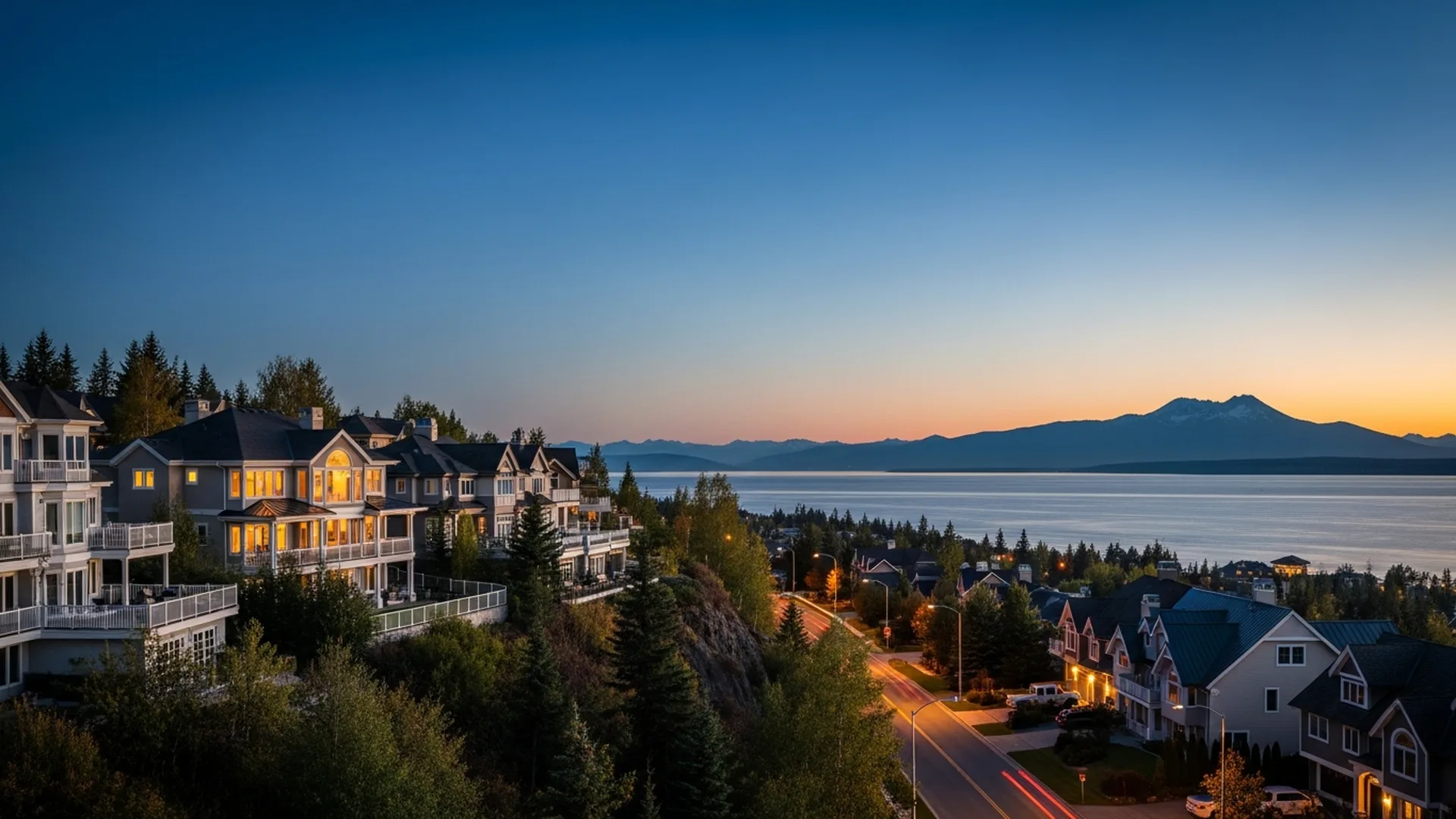
Bootlegger Cove is a small, close-in coastal neighborhood on the west edge of downtown Anchorage, sitting on the bluff above the Cook Inlet tidal flats between Westchester Lagoon and the downtown core. It is one of the city’s earliest residential areas, so its appeal is location and character — walkable downtown, direct Tony Knowles Coastal Trail access, and west-facing lots that can capture Cook Inlet and Alaska Range views — rather than new construction. The neighborhood also lends its name to the Bootlegger Cove Formation, the glacial clay first identified here, which is why a site-specific geotechnical and structural review is a sensible step on any close-in bluff property. For luxury buyers, the trade is an irreplaceable near-downtown position and view; for sellers, value concentrates in the sightline, walkability, and the documented condition of an older home.
Of all the places I show buyers in West Anchorage, Bootlegger Cove is the one that most rewards walking the block before you ever open a listing sheet. It is a compact pocket of homes pressed against the west edge of downtown, up on the bluff over the water — and the difference between an average lot and an exceptional one here can be a matter of a few feet of elevation and which way the living room faces. Buyers who tour it in person consistently understand it faster than any set of photos can convey.
The neighborhood carries more real history than almost any other close-in address in the city, and that history is not just charming trivia — it shows up in the age of the housing stock and, quite literally, in the geology under the streets. This guide walks through what actually makes Bootlegger Cove distinctive, what to check before you buy, and what drives value if you own here and are thinking of selling.
- Bootlegger Cove sits on the bluff above the Cook Inlet tidal flats, about half a mile west-southwest of downtown Anchorage and northeast of Westchester Lagoon; its boundaries have always been treated as informal.
- The name dates to Prohibition — smugglers landed liquor near the Chester Creek mouth, out of sight around the bend from Ship Creek; the first recorded use of the name is 1933.
- West- and northwest-facing bluff lots can capture Cook Inlet water views and, on clear days, the Alaska Range across the water — but view quality varies sharply by exact position and orientation.
- It is one of Anchorage’s earliest residential areas, adjacent to the 1915 townsite, so much of the stock predates modern seismic codes and value leans on location and character over newness.
- The Bootlegger Cove Formation — a glacial clay first identified here — underlies much of Anchorage; sensitive layers within it contributed to the 1964 earthquake landslides, making a site-specific geotechnical and structural review prudent.
- Direct Tony Knowles Coastal Trail access, Elderberry Park, and the 1915 Oscar Anderson House (the first wood-frame house in Anchorage) are all at the neighborhood’s doorstep.
Where Is Bootlegger Cove, and Why Is It Positioned the Way It Is?
Bootlegger Cove is a coastal neighborhood on the west edge of downtown Anchorage, sitting above the tidal flats of Cook Inlet. Reference geography places it roughly 0.5 miles west-southwest of the downtown core and about 0.73 miles northeast of Westchester Lagoon, with the Alaska Railroad and the Tony Knowles Coastal Trail running along the shoreline between the homes and the water. It is described as being just west of Downtown Anchorage and north of the South Addition — and its exact boundaries have long been considered controversial and informal rather than surveyed.
That position is the whole story of the neighborhood. Unlike the lakefront enclaves to the south — Campbell Lake and Sand Lake, where the water is a private amenity you launch a float plane from — Bootlegger Cove’s water is Cook Inlet itself, viewed from a bluff, with the Coastal Trail as the shared front yard. You are buying proximity: to downtown, to the trail system, and to a west-facing horizon.
| Attribute | Bootlegger Cove |
|---|---|
| Location | West edge of downtown Anchorage; ~0.5 mi W of the core, ~0.73 mi NE of Westchester Lagoon |
| Setting | On the bluff above the Cook Inlet tidal flats |
| Primary view | West to Cook Inlet; Alaska Range on clear days (varies by lot) |
| Shoreline | Alaska Railroad & Tony Knowles Coastal Trail run between homes and water |
| Housing stock | Mostly older / character-rich; area adjacent to the 1915 townsite |
| Key due diligence | Site-specific geotechnical & structural review (Bootlegger Cove Formation) |
What Kind of Homes Are in Bootlegger Cove?
This is one of Anchorage’s oldest residential pockets, and the housing reflects it. Local resources describe a mix of single-family homes with larger yards alongside condominiums, and note that the area is also home to some genuinely nice luxury houses with downtown, park, and trail access at the doorstep. Because the neighborhood grew up next to the original 1915 townsite, a meaningful share of the stock is decades old — some homes predating modern seismic building codes entirely.
For a luxury buyer, that changes what you are paying for. Unlike a new-construction subdivision where the premium is in the build itself, here the premium is in the position: the view, the walkability, and the character. The best-value purchases I see are homes that have been thoughtfully and correctly updated over the years, where the sightline is real and the structure has been maintained — not homes bought on charm alone with deferred work hiding behind fresh paint.
Why Do These Homes Have Cook Inlet Views — and How Do You Read Them?
The neighborhood sits on the bluff fronting the tidal flats, so west- and northwest-facing lots are oriented straight at the water. On a clear day that can mean Cook Inlet in the foreground and the Alaska Range across it — the kind of sightline that is genuinely scarce this close to downtown. But “view” in Bootlegger Cove is not a single thing. It changes with elevation on the bluff, with which direction the primary rooms face, and with what has been built or grown between the home and the water.
The practical read: verify the sightline from the specific rooms you’ll actually live in, at the elevation the home sits at, and consider how protected that view is from future obstruction. A view that depends on a neighbor’s vacant parcel staying vacant is a different asset than one anchored to the bluff edge.
What Should Buyers Know About the Bootlegger Cove Formation and Seismic Risk?
This is the moat topic here, and it is unusual: the neighborhood gave its name to a geologic unit. The Bootlegger Cove Formation — also called the Bootlegger Cove Clay — is a glacial estuarine-marine deposit that was first identified in this downtown coastal subdivision, which is exactly why it carries the name. Per the U.S. Geological Survey, it is a composite of mixed gravel, sand, silt, and clay laid down over much of upper Cook Inlet during the late Pleistocene, and it underlies much of the Anchorage area — not just this neighborhood.
Its relevance to real estate comes from the 1964 Great Alaska Earthquake. According to USGS, the most devastating damage in Anchorage came from landslides triggered when sensitive clay layers within the formation lost strength under roughly 4.5 minutes of shaking, allowing overlying blocks of soil to slide sideways along nearly horizontal surfaces — the mechanism behind the L Street, Fourth Avenue, Government Hill, and Turnagain Heights slides. The Municipality of Anchorage’s downtown seismic risk assessment documents that in the L Street area, failure of the clay produced ground displacements exceeding ten feet.
None of this makes Bootlegger Cove uniquely risky — the formation underlies a broad swath of the Anchorage lowland, and thousands of homes sit on it. It does mean that on any close-in coastal or bluff property, a site-specific geotechnical understanding and a competent structural review are the right due-diligence steps, exactly as they would be on a comparable bluff lot elsewhere in the bowl. The goal is an informed purchase, not fear.
A sensible due-diligence checklist here
What to confirm
Any available soils / geotechnical information for the site; the home’s structural and foundation condition; the age and code era of the build and any additions; documentation of past remodels and permitted work; how protected the view is.
What varies (verify, don’t assume)
Exact neighborhood boundaries (informal); the specific soil profile under a given lot; view quality by exact position; whether older updates were done to modern standards. These differ property to property and shouldn’t be generalized from the neighborhood name.
What Is It Like to Live at the Edge of Downtown Here?
The lifestyle draw is walkability that almost nowhere else in Anchorage matches for a bluff-view setting. The neighborhood has direct access to the Tony Knowles Coastal Trail along the shore, plus Elderberry Park at its northwest corner. That park is home to the Oscar Anderson House — built in 1915, the first wood-frame house in Anchorage, listed on the National Register of Historic Places, and today the city’s only historic house museum. Westchester Lagoon and the Chester Creek trail system are a short distance to the southwest.
Sellers routinely underestimate how much this walk-and-bike access to the water and downtown moves a buyer emotionally. Buyers touring the trail on a summer evening — watching the light hold over the Inlet late into the night — consistently connect the location to the price in a way that a spec sheet never captures.
Thinking of Selling in Bootlegger Cove? What Drives Value Here
If you own in Bootlegger Cove, your value concentrates in three things: the Cook Inlet sightline, the walkable near-downtown and Coastal Trail position, and the condition and character of an older home. Those first two are irreplaceable — no new subdivision can manufacture a bluff-view lot a half-mile from downtown — so the lever you actually control is the third.
This is where I lean on my background in design. With a degree in Interior Design and a career in furnishings and design behind me, I read finishes, light, and flow the way a buyer will, and I can tell you where a modest, correct update earns its money in an older home versus where it’s wasted. Presenting an older Bootlegger Cove home well — and documenting its maintenance, remodels, and structural history — gives buyers the confidence to pay for the location rather than discount for uncertainty. When you’re ready, the best next step is a real, data-backed look at your home’s value. You can start with my Anchorage home value page.
- U.S. Geological Survey — Effects of the earthquake of March 27, 1964, at Anchorage, Alaska (PP542A) and the USGS 1964 Great Alaska Earthquake Anchorage Walking Tour: Bootlegger Cove Formation composition, landslide mechanism, and neighborhood-naming origin of the formation.
- Municipality of Anchorage — Downtown Anchorage Seismic Risk Assessment (executive summary): documented ground displacement in the L Street slide area from failure of the Bootlegger Cove Clay.
- Municipality of Anchorage, Office of Historic Preservation — Oscar Anderson House Museum (Elderberry Park), first wood-frame residence after the 1915 townsite auction; National Register listing.
- Anchorage Daily News (historian David Reamer) — origin of the Bootlegger Cove name; first recorded use in 1933; the 1925 Chester Creek liquor seizure.
- Wikipedia (Bootleggers Cove, Anchorage) — general location, informal boundaries, scenic features, and neighborhood context (secondary; corroborated against the primary sources above).
Considering a Bootlegger Cove home?
Let’s walk the lot, read the view, and check what matters before you offer. Call Bill at 907-560-4090.
Frequently Asked Questions
Bootlegger Cove is a small coastal neighborhood on the west edge of downtown Anchorage, roughly half a mile west-southwest of the downtown core and northeast of Westchester Lagoon. It sits on the bluff above the Cook Inlet tidal flats, with the Alaska Railroad and the Tony Knowles Coastal Trail running along the shoreline between the homes and the water. Its exact boundaries have long been treated as informal rather than fixed.
The name comes from the Prohibition era, when the Alaska Bone Dry Law of 1918 banned alcohol. The stretch of coast near the mouth of Chester Creek — tucked around a bend from Ship Creek and out of sight of authorities — became a favored landing spot for smugglers bringing liquor ashore. The first recorded use of the name dates to 1933, the same year Prohibition was repealed in Alaska and nationally.
The Bootlegger Cove Formation is a glacial estuarine-marine clay deposit first identified in this neighborhood, which is why it carries the name. Per USGS, sensitive clay layers within it can lose strength under prolonged shaking, which contributed to the major 1964-earthquake landslides. It underlies much of the Anchorage lowland, not just this neighborhood, so a site-specific geotechnical and structural evaluation is the right due-diligence step for any close-in coastal or bluff property.
Many do. Because the neighborhood sits on a bluff above the tidal flats, west- and northwest-facing lots can capture Cook Inlet water views and, on clear days, the Alaska Range across the water. View quality varies sharply by exact position, elevation, and orientation, so the sightline is worth verifying in person from the specific property rather than assumed from the address.
Yes. Bootlegger Cove is one of Anchorage’s earliest close-in residential areas, adjacent to the 1915 townsite, and much of its housing stock predates modern seismic building codes. For a luxury buyer that means value is often in location, view, and character rather than new construction, and a careful review of updates, additions, and structural work — including how a home has been maintained or remodeled — matters more than in a newer subdivision.
The neighborhood has direct access to the Tony Knowles Coastal Trail along the shoreline, plus Elderberry Park — home to the Oscar Anderson House Museum, the first wood-frame house in Anchorage, built in 1915. Westchester Lagoon and the Chester Creek trail system are also close by. This walk-and-bike access to the water and downtown is one of the neighborhood’s defining features.
The biggest value drivers are the Cook Inlet sightline, walkable proximity to downtown and the Coastal Trail, and the condition and character of an older home. Well-executed, code-appropriate updates and a documented maintenance and structural history tend to reward sellers, because buyers here are paying for an irreplaceable location and want confidence in the building itself.