

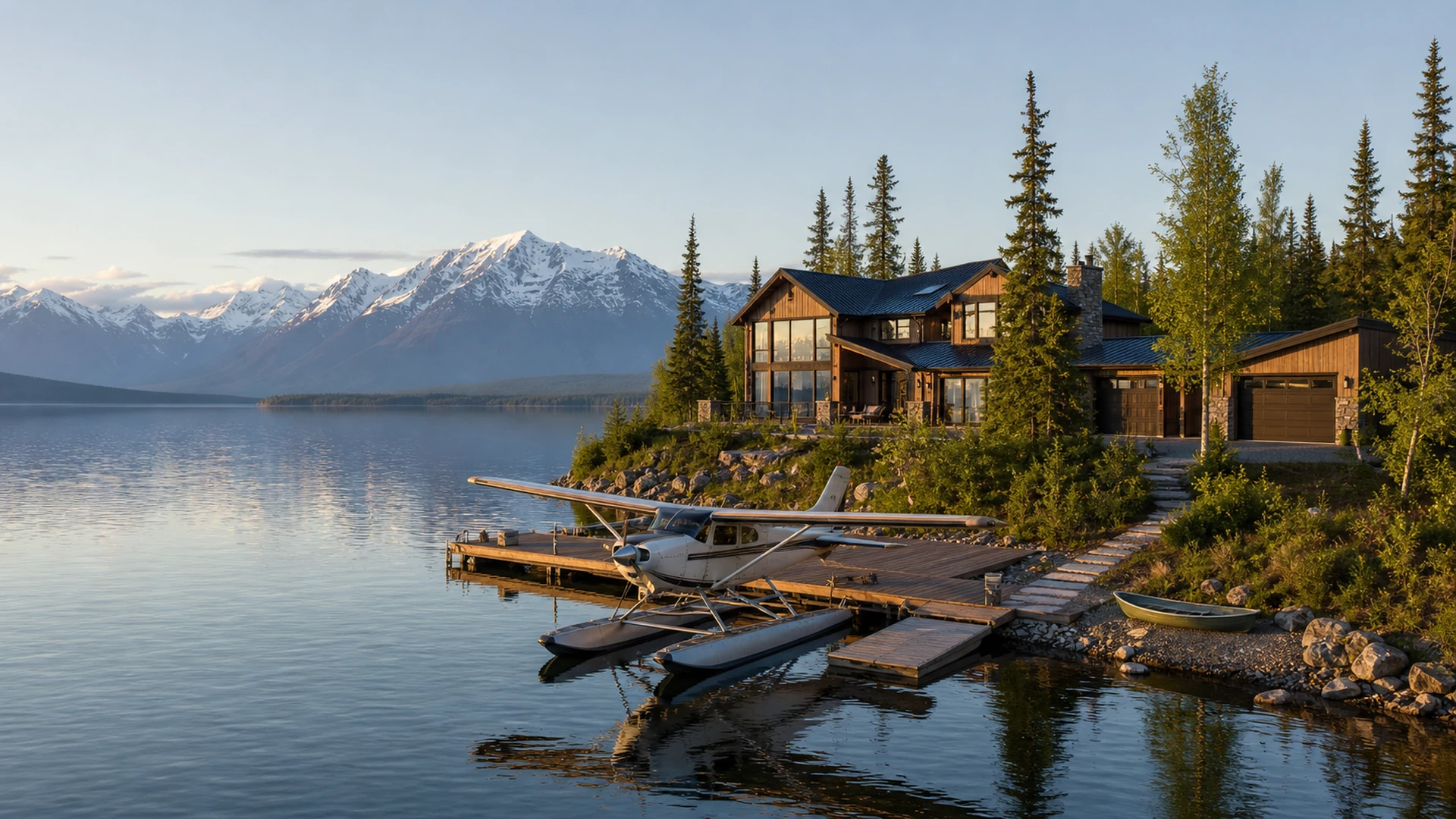
In the Greater Anchorage corridor and Mat-Su Valley, “lake home” and “floatplane access” can mean very different things, and the distinction lives in the title and plat rather than the listing remarks. The three tiers that drive value are deeded waterfront (your lot legally touches the water), shared common-area or easement access, and “near the lake” with no legal water right at all. On a genuine floatplane lake — Lake Hood and Lake Spenard in Anchorage, or Mat-Su lakes such as Big Lake and Wasilla Lake — an owner can taxi an aircraft to a private ramp instead of joining a multi-year slip waitlist. Before buying, the essentials to verify are the exact water right, whether the lake truly supports floatplane use, invasive-weed (Elodea) history, dock permitting, public-access status on navigable water, and the seasonal freeze cycle.
Water-access homes are a signature of Southcentral Alaska living, and they are also where I see buyers make the most avoidable mistakes. Two listings can both say “lake access,” sit a mile apart, and describe legally different things — one where the deed carries frontage and dock rights, and one where the owner shares a distant common launch. Having watched this corridor for four decades, I’ve learned that the water is the easy part to fall in love with; the paperwork behind it is what determines whether you bought a lake home or a house that merely looks at one.
This guide walks through how lake and floatplane-access property actually works here — the legal tiers of water access, how Alaska’s uniquely public waters affect private shoreline, the invasive-weed problem that quietly moves values, dock and slip realities, and the seasonal rhythm that governs everything from aircraft use to inspections. It applies across the market: Anchorage lake neighborhoods like Campbell Lake and the Sand Lake area, and the deep bench of Mat-Su lakes from Big Lake to Wasilla Lake.
- Water access falls into three legally distinct tiers — deeded waterfront, shared common-area/easement access, and “near the lake” with no legal right — and the MLS often blurs them.
- In the Mat-Su, deeded waterfront has commonly carried a meaningful premium over similar non-waterfront homes in the same area, with shared access falling in between.
- Lake Hood in Anchorage is the world’s busiest seaplane base, with a reported floatplane-slip waitlist around 13 years — which is precisely why private lakefront water access is prized.
- Under the Alaska Constitution and statute, owning shoreline on navigable or public water does not grant exclusive control of the water; the public/private line is the ordinary high water mark.
- Elodea, an invasive aquatic plant found in several Anchorage lakes since 2011, can impair floatplane operations, recreation, habitat, and property values — ask about it directly.
- Floatplane use is seasonal, roughly ice-out (late May/early June) to freeze-up (late Sept/early Oct), after which some lakes shift to ski-plane use on the ice.
- Most Mat-Su and outlying lake homes rely on private wells and on-site septic, so water/wastewater due diligence belongs in the unfrozen testing window.
What Does “Lake Access” Legally Mean in the Anchorage and Mat-Su Market?
The single most important thing to understand is that “waterfront” and “lake access” are not the same, and neither is guaranteed by a pretty photo. Local market practice in the Mat-Su breaks water access into a strict hierarchy: deeded waterfront, where your lot actually touches the water and you own a portion of shoreline; shared common-area access, where a subdivision boat launch or common lot is used by many owners; and “near the lake,” where there is no legal access at all. As one Mat-Su waterfront brokerage bluntly puts it, deeded waterfront commands a clear premium over shared access, which still beats listings with no legal water right — and the MLS doesn’t always make these distinctions clear.
That last point is the trap. Unlike a mountain view, which you can confirm by standing in the yard, a water right is only visible in the title, the plat, and the recorded easements. A listing can honestly advertise “lake access” when what conveys is a shared launch two streets over. Reading those documents — not the marketing remarks — is the difference between buying a lake home and buying a road-side house with a view.
| Step | What you’re verifying | Where to look |
|---|---|---|
| 1. Water-access tier | Deeded waterfront vs. shared easement vs. “near the lake” | Title, plat, recorded easements/CCRs |
| 2. Floatplane usability | Length, depth, obstacles; allowed vs. restricted use | Lake data, HOA/subdivision rules, local knowledge |
| 3. Lake health | Elodea / invasive weeds and treatment history | Alaska DEC, ADF&G, HOA records |
| 4. Dock / slip | Permitted? Owned or assigned? | Permits, HOA docs, federal/state/local agencies |
| 5. Public access | Navigability; ordinary high water mark line | Alaska DNR / ADF&G, reserved easements |
| 6. Seasonality + systems | Ice timing; well & on-site septic condition | Inspections in the unfrozen window |
How Does Floatplane Access Actually Work Around Anchorage?
Anchorage is the world capital of this lifestyle. Lake Hood Seaplane Base — two connected bodies of water, Lake Hood and Lake Spenard, joined by a canal next to Ted Stevens Anchorage International Airport — is the busiest seaplane base on Earth, handling an average of roughly 190 flights per day with hundreds of aircraft based there. What makes it relevant to homebuyers is that residential lots line those shores with private airplane parking, and owners taxi floatplanes right up to their backyards: walk out the back door, untie the airplane, taxi to a water lane, and fly, with no commute to the airport and no hangar rental.
The reason that private access is so valuable comes down to scarcity. A State of Alaska economic-impact study on Lake Hood reported a waiting list of roughly 13 years for a floatplane slip and about three years for a tie-down spot — tie-downs that are effectively generational assets passed down within families. A lot with its own deeded water access lets an owner sidestep that entirely, which is a genuine, durable value driver rather than a marketing flourish.
Beyond Lake Hood, the same lifestyle appears on select lakes across the corridor. In Anchorage, Campbell Lake and lakes in the Sand Lake area have long supported floatplane-studded shorelines and lakefront homes. In the Mat-Su, Big Lake and Wasilla Lake anchor active waterfront markets known specifically for lakefront homes, docks, and floatplane access, and some subdivisions are laid out for hangar-style homes where an owner can taxi to the lake via a community launch and common area. Note that use rules differ lake by lake — some lakes welcome floatplanes but restrict gas-powered boats, and others are the reverse.
Who Really Owns an Alaska Lake — and Can the Public Use the Water in Front of Your House?
This surprises nearly every out-of-state buyer. Alaska protects public water use at the constitutional level. Under the Alaska Constitution (Article VIII, Section 14) and state statute, owning the uplands next to navigable or public water does not grant an exclusive right to use the water or to control public use of it — even if your title includes the submerged land. The boundary between private and public is the ordinary high water mark, and land below it on navigable or public water is subject to the public’s right to use it for purposes like fishing, boating, and hunting, per the Alaska Department of Fish and Game.
The practical nuance: the public’s right is to the water, not to cross your dry uplands to reach it, and a genuinely non-navigable lake can be treated differently. Anchorage’s Campbell Lake is the famous illustration — long treated by residents as a “private” floatplane lake, its actual navigability and public-access status have been publicly disputed. The lesson for a buyer isn’t alarm; it’s that navigability and any reserved public-access easement are specific facts to confirm through the state and the title, not to assume from how a neighborhood feels.
What Is Elodea, and Why Should a Lake Buyer Care?
Here is a moat issue almost no general listing will flag. Elodea is an invasive aquatic plant that was discovered in dense growths in Anchorage’s Sand Lake, along with nearby DeLong and Little Campbell lakes, back in 2011 — likely introduced by a dumped home aquarium. It matters because Elodea can negatively impact floatplane operations, recreation, fish and wildlife habitat, and, explicitly, property values. Dense weed mats can foul a floatplane’s takeoff run and tangle props and rudders.
Because Alaska agencies have treated affected lakes, a specific, answerable question on any lake purchase is whether the water body has an Elodea history and what treatment or monitoring exists. Unlike a cosmetic defect you can renegotiate after inspection, a lake-health problem is shared by every owner on the water — so it’s a pre-offer question, not a post-inspection one.
What About Docks, Slips, and Building on the Shore?
A dock is where lake ownership meets regulation. Lakefront (littoral) rights generally let an owner use the water and build a dock to reach navigable depth, but a dock cannot obstruct the public’s right to navigate, and dock construction typically requires permitting. On navigable waters, that can involve overlapping approvals — a federal permit (such as under the Rivers and Harbors Act or Clean Water Act), a state environmental permit, and a local building permit — with rules on size, placement, materials, and spacing. In HOA or subdivision settings, docks and slips are often communally owned and assigned rather than individually built, so “a dock” in the remarks may mean “shared use, subject to availability.”
Strengths of a true water-access home
- Deeded frontage sidesteps multi-year slip/tie-down waitlists
- Durable scarcity value in a contained, lightly-contested luxury market
- Year-round recreation: boating and floatplanes in summer, skis and snowmachines in winter
- Direct, backyard aircraft access on the right lake
What deserves scrutiny
- Water right may be shared or absent despite “access” wording
- Public may have rights to the water below the high-water mark
- Invasive-weed (Elodea) exposure affects the whole lake
- Docks may be permitted, assigned, seasonal, or all three
- Well/septic + seasonal access add rural due diligence
How Do Season and Freeze-Up Shape a Floatplane Property?
Everything on a lake home runs on the ice calendar. Alaska float-flying season is tied to open water — local flight schools generally put aircraft on floats once lake ice thaws (often late May or early June) and swap back to wheels before lakes freeze (commonly by late September or early October), with exact dates varying year to year. Once a lake is solidly frozen, many shift to ski-plane operations; at Lake Hood, the state maintains plowed runways directly on the ice.
For a buyer, this seasonality touches three practical things: aircraft and dock use are open-water activities; a lake’s look and depth change across the year; and because most Mat-Su and outlying lake homes rely on private wells and on-site septic, the well/septic and on-site wastewater checks belong in the unfrozen window when the ground can actually be tested. If you’re touring in deep winter, plan those inspections deliberately rather than waiving them for speed.
Mat-Su waterfront spans a wide band — from modest older cabins on smaller lakes up to seven-figure deeded homes on Big Lake and Wasilla Lake — and deeded frontage has generally carried a clear premium over shared access within the same area. Because the corridor’s luxury inventory is scarce and lightly contested, a well-documented water right tends to hold value across market cycles. These are structural dynamics, not a dated price quote; confirm current figures against live Alaska MLS data.
This information is general and educational, not legal, tax, or financial advice. Water rights, navigability, permitting, and title questions are fact-specific and can carry real consequences — consult a licensed attorney, title professional, and the relevant Alaska agencies about your specific property before relying on any of it.
- Alaska Department of Fish & Game, Division of Sport Fish — Public Access to Alaska Waters (constitutional right of access; ordinary high water mark; AS 38.05.126).
- Alaska Department of Natural Resources, Division of Mining, Land & Water — State Policy on Navigability (public vs. private boundary; ordinary high water mark; navigability test).
- Alaska Statutes via akleg.gov / Justia — AS 38.05.127 (reservation of access easements to navigable or public water).
- Alaska DOT&PF / AEDC — Lake Hood Seaplane Base Economic Impact Study (world’s busiest base; ~13-year floatplane-slip and ~3-year tie-down waitlists; operations data).
- Wikipedia (secondary) — Lake Hood Seaplane Base and Sand Lake (Anchorage) (base description; Elodea discovery in Sand Lake, DeLong, Little Campbell lakes, 2011; lake facts).
- Seaplane Pilots Association / FAA references — single-engine sea (SES) rating requirements; seaplane operations background.
- Alaska float-training operators (Alaska Float Ratings, Blue River Aviation) — float season timing tied to ice-out/freeze-up.
- Mat-Su and Anchorage market sources (deeded vs. shared waterfront hierarchy; Big Lake / Wasilla Lake floatplane communities) — for verification against live Alaska MLS data.
- The Alaska Landmine — reporting on Campbell Lake’s navigability/public-access dispute.
Thinking About a Lake or Floatplane Home?
Bill reads the plat, the water rights, and the lake — before you fall for the view.
Frequently Asked Questions
Deeded waterfront means your lot legally touches the water, while lake access usually means a shared common-area easement or boat launch that several owners use. There is also a third category — “near the lake” — that carries no legal water right at all. In the Mat-Su, deeded waterfront typically commands a clear premium over shared access, which still beats a road-side house with only a view, so the title and plat matter more than the listing wording.
Yes, on certain lakes. Residential lots line the shores of Lake Hood and Lake Spenard with private airplane parking, and some homeowners taxi a floatplane right up to their own backyard ramp or dock. The same lifestyle exists on select Mat-Su lakes such as Big Lake and Wasilla Lake and on some Anchorage lakes, but the water body must actually support floatplane operations and the property must have the legal right to use it.
According to a state economic impact study, Lake Hood — the world’s busiest seaplane base — has carried a waiting list of about 13 years for a floatplane slip and roughly three years for a tie-down spot. That scarcity is exactly why lakefront lots with their own private water access are so highly valued, because they let an owner skip the wait entirely.
Not necessarily. Under the Alaska Constitution and state statute, owning the uplands next to navigable or public water does not grant an exclusive right to use the water or to control public use of it, even if your title includes the submerged land. The public-versus-private boundary is the ordinary high water mark. On a genuinely non-navigable lake the rules can differ, so navigability status is a specific thing to confirm rather than assume.
Elodea is an invasive aquatic plant first found in Anchorage’s Sand Lake, DeLong, and Little Campbell lakes in 2011, likely introduced from a dumped aquarium. It matters because dense growth can negatively affect floatplane operations, recreation, fish and wildlife habitat, and property values. Before buying on any lake, ask about Elodea and any Alaska DEC or Fish and Game treatment history.
Confirm the exact water right in the title and plat, then evaluate lake and waterfront quality, dock potential, and whether the lake supports the recreation or floatplane use you want. Because Mat-Su lake homes rely on private wells and on-site septic, review those systems, plus road access and winter maintenance. The MLS doesn’t always distinguish deeded waterfront from shared access, so the records need reading, not just the remarks.
To act as pilot-in-command of a floatplane you generally need a private pilot certificate with a single-engine sea (SES) rating, which is a seaplane class rating added to your certificate through instruction and an FAA checkride. Owning a floatplane-access home doesn’t require any certificate — you can keep a hangar-style home and hire charter operators — but flying your own aircraft off the lake does.
Floatplane season is tied to open water, typically from ice-out in late May or early June through freeze-up around late September or early October, though exact dates vary year to year. Many Alaska lakes then shift to ski-plane use once solidly frozen; at Lake Hood the state even maintains plowed runways on the ice. For a homebuyer, this means aircraft access, dock use, and water testing are all seasonal considerations.