

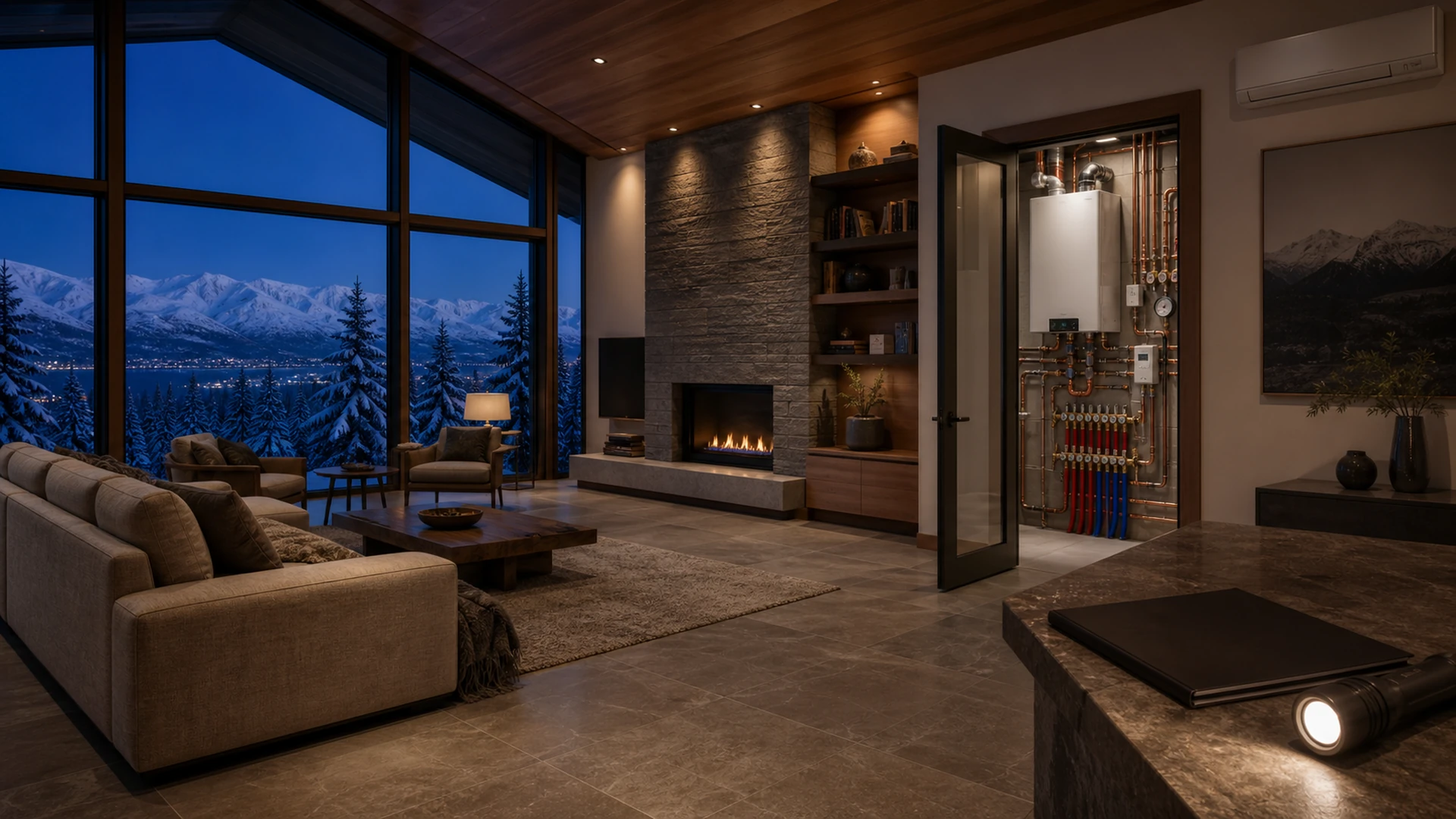
Most Anchorage and Southcentral Alaska homes are heated with natural gas, delivered by ENSTAR Natural Gas across the Anchorage Bowl, the Mat-Su Valley, and the Kenai Peninsula. Inside that gas service area you will typically find a high-efficiency forced-air furnace or a gas-fired hydronic boiler feeding baseboards or radiant floors; outside it, heating oil is the traditional fuel. Cold-climate air-source heat pumps are a fast-growing option, usually paired with a backup heat source for the coldest stretches, since Anchorage's design low is roughly -18°F. When I walk a home with buyers, the heating system is never an afterthought — fuel type, efficiency, age, and utility history all bear on both comfort and long-term cost.
Heating is not a footnote in an Alaska home purchase — it is one of the systems that most affects how a house feels to live in and what it costs to own. Having lived in Anchorage for forty years, I have toured homes on the coldest mornings of the year, and the difference between a well-designed heating system and a neglected one is obvious the moment you step inside. This guide explains the systems you will actually encounter in the Anchorage area, how they compare, and the practical questions a buyer should ask — grounded in current, citable Alaska sources rather than generic advice.
Anchorage sits in ASHRAE Climate Zone 7, a cold-climate classification, with a 99% heating design temperature of roughly -18°F — much milder than Fairbanks, but still demanding on equipment sizing and building envelope. That climate, combined with Southcentral's natural-gas infrastructure, shapes nearly every heating decision here.
- Natural gas dominates the Anchorage Bowl; ENSTAR Natural Gas has served Southcentral Alaska since 1961 and reports 140,000-plus customers.
- The two most common gas setups are high-efficiency forced-air furnaces (commonly 90–98% AFUE in modern installs) and gas-fired hydronic boilers feeding baseboards or radiant floors.
- Hydronic radiant floor heat is prevalent in well-insulated custom and slab construction and is prized for even, draft-free warmth.
- Cold-climate air-source heat pumps are expanding rapidly, rated to operate well below zero, but are almost always installed with a backup heat source in Anchorage.
- Older Anchorage homes (1970s–80s) may still run 40–60% efficient boilers or 60–70% AFUE furnaces — a meaningful replacement consideration.
- Cook Inlet gas production has declined, and utilities are planning LNG imports that are widely expected to raise gas prices in the coming years.
- Heating-related rebate programs (AHFC, federal) change with funding and law — the federal 25C heat pump credit expired December 31, 2025 — so verify current status before planning.
What Fuel Heats Most Anchorage Homes?
In the Anchorage Bowl, the answer is almost always natural gas. ENSTAR Natural Gas Company — the largest utility in Southcentral Alaska, in service since 1961 — delivers gas across Anchorage, the Mat-Su Valley, and the Kenai Peninsula, serving well over 140,000 customers. Where gas is available, it has historically been the most cost-effective heating fuel, thanks to Cook Inlet gas production that kept Southcentral rates among the lowest in the nation.
Outside the gas service area — some outlying acreage, parts of the Valley, and more remote parcels — heating oil remains the traditional fuel, and it is meaningfully more expensive to run. Propane is used where neither gas nor oil is practical, and direct-vent oil space heaters (often called Toyo or monitor stoves) still serve some homes as a primary or supplemental source. Unlike a Fairbanks buyer, who may have no gas option at all, an Anchorage buyer's first heating question is usually simple: is this specific address inside ENSTAR's service area? That single fact can shift long-term operating costs substantially.
ENSTAR will confirm whether gas is available at a given property based on its lot, block, and subdivision. If you are comparing homes and one is on gas while another relies on oil or propane, treat that as a real line item in your ownership cost — not a rounding error.
How Do Alaska's Main Heating Systems Compare?
Most Anchorage-area homes use one of four approaches. Each has a distinct comfort profile, cost structure, and behavior in deep cold. The graphic below summarizes the trade-offs; the companion table repeats the same facts in text.
| System | Typical efficiency | Comfort profile | Behavior in deep cold |
|---|---|---|---|
| Gas forced-air furnace (most common) | ~90–98% AFUE (modern) | Fast warm-up; some drafts | Unaffected |
| Gas hydronic boiler (baseboards/radiators) | ~90–95% AFUE | Even, quiet heat | Unaffected |
| Hydronic radiant floor (custom/slab) | Low-temp, efficient | Most even; warm floors | Unaffected |
| Cold-climate air-source heat pump | Very high COP at mild temps | Even; provides cooling too | Degrades in deep cold; needs backup |
Why Do So Many Anchorage Luxury Homes Have Radiant Floor Heat?
Hydronic radiant floor heat — warm water circulated through tubing embedded in a slab or subfloor — is one of the most comfortable systems for a cold-climate home. Unlike forced air, it eliminates drafts and delivers warmth at floor level, and in a well-insulated home the floor keeps radiating heat long after the system cycles off. That is exactly why it shows up so often in custom and slab-on-grade luxury builds across the Hillside and premium new construction: it runs at lower water temperatures, pairs beautifully with open floor plans and large view windows, and simply feels better underfoot on a dark January morning.
The trade-off is upfront cost. Hydronic systems can cost several times more to install than a basic electric or forced-air setup, though they tend to be less expensive to operate over the long run. Radiant is also commonly extended outdoors in higher-end Anchorage homes as snowmelt systems in driveways and walkways — a genuine luxury feature that eliminates shoveling and reduces slip hazards.
Do Heat Pumps Actually Work in Anchorage Winters?
Increasingly, yes — with an important caveat. Cold-climate air-source heat pumps use variable-speed compressors to keep producing heat well below zero, and Anchorage has become the state's leading urban market for them, supported by utility interest and rebate programs. Many models are rated to operate to roughly -13°F, and some lower. Because heat pumps move heat rather than burn fuel, they are dramatically efficient at moderate temperatures — and they provide summer cooling, an increasingly valued feature.
The caveat is Anchorage's design low of about -18°F. At the coldest edges of the winter, a heat pump's output falls off, so nearly every Anchorage installation pairs the heat pump with a backup: an existing gas furnace or boiler, or electric resistance heat. The smart way to think about it is a highly efficient primary system with a reliable backstop — not a stand-alone replacement for combustion heat. For a buyer, a home with a well-designed heat pump plus gas backup can be the best of both worlds; a heat pump with no credible backup deserves harder questions.
Where a heat pump makes sense here
- Paired with existing gas or electric backup
- Owner wants summer cooling as well as heat
- Home currently on expensive oil or propane
- Well-sealed, well-insulated envelope
Where to ask harder questions
- No credible backup heat source
- Electrical panel may need an upgrade
- Leaky, poorly insulated older home
- Rebate assumed but not yet confirmed
What Does It Cost to Heat an Anchorage Home?
Honest answer: it depends heavily on home size, insulation, fuel, and habits, and published figures are ranges, not guarantees. One 2026 Alaska heating guide estimated a typical Anchorage home at roughly $150–$350 per month in winter, or about $1,200–$2,800 per year; another source cites $2,000–$4,000 annually for a typical household. Natural gas is generally the most affordable fuel in the Bowl, while heating oil and propane run significantly higher. Interior Alaska homes facing -40°F winters spend far more than Southcentral homes.
Because these are estimates, the single most useful thing a buyer can do is request the actual utility history for the specific home. Two similar-looking houses on the same street can have very different bills depending on envelope quality and system age — which is why I always push for real numbers rather than rules of thumb.
Is Natural Gas Going to Stay Cheap in Southcentral Alaska?
This is the most important forward-looking heating question in the market right now, and it deserves a straight answer: the long-term picture is uncertain. Cook Inlet gas production has declined for years — down to roughly 70 billion cubic feet per year basin-wide — and Hilcorp, the region's dominant producer, has warned it cannot meet utilities' upcoming demand as contracts expire. Southcentral utilities are planning to import liquefied natural gas (LNG) to fill the gap, which multiple sources say is expected to raise bills.
Concretely: ENSTAR has advanced an LNG import project (with Glenfarne) targeting first imports around 2029, and its supply contract with Hilcorp runs through 2033; a separate Harvest/Chugach import effort at Nikiski is also in the works. Utilities have said near-term winter supply is being met — during a cold snap in late 2025, ENSTAR reported it was not concerned about serving customers — but the structural challenge remains. For a buyer, this doesn't argue against a gas home; it argues for factoring in potential upward pressure on gas rates over the coming years, and for valuing a well-insulated home whatever the fuel.
The Southcentral gas situation is genuinely fluid, with projects, timelines, and pricing still evolving. Treat any specific future price as a projection, not a fact, and confirm the current outlook with ENSTAR and current reporting when it matters to your purchase.
Are There Rebates for Heating Upgrades in Alaska?
Sometimes — but availability shifts with state funding and federal law, so this is an area to verify before you count on it. As of early 2025, AHFC launched a $10,000 New Home Construction Rebate for homes with foundations completed on or after January 2, 2025 built to a 5-Star Plus energy rating, with no income qualification and an 18-month build window. AHFC's Home Energy Rebate and the income-qualified HEEHRA heat pump rebates are tied to a pre-installation assessment by an AHFC-certified energy rater — equipment replacement alone generally does not qualify; the improvement must produce a measurable energy-rating gain.
On the federal side, note an important recent change: the Section 25C heat pump tax credit expired December 31, 2025 and is not available for systems installed in 2026. Homeowners who installed a qualifying heat pump by that deadline may still claim it on their 2025 return. Because these programs open, close, and change, always confirm current status with AHFC (ahfc.us/efficiency) before planning a project, and be wary of unsolicited "rebate" sales pitches.
This information is general and educational, not legal, tax, or financial advice. Rebate, tax-credit, and utility-cost details change frequently; consult AHFC, the IRS, ENSTAR, and a licensed professional about your specific situation before making decisions.
What Should You Check About the Heating System Before You Buy?
Here is the practical due-diligence sequence I walk buyers through on any Anchorage-area home:
A few specifics worth emphasizing. Boiler and hydronic systems reward maintenance: a system flush every three to five years clears sludge that can cause cold rooms and, at worst, cracked pipes, and annual service is standard for any system here. Older homes deserve extra scrutiny — many Anchorage houses built in the 1970s and 1980s still run boilers around 40–60% efficient, and a modern condensing gas boiler near 95% can pay for itself over time. Any equipment replacement in the Municipality typically requires permitting under the Alaska Mechanical Code, with permit closure confirming an inspection. Finally, have an Alaska-licensed mechanical contractor evaluate the system during your inspection period — it is inexpensive insurance on one of the home's most important systems.
- ENSTAR Natural Gas Company — utility history, service area, and Southcentral customer base (enstarnaturalgas.com; Anchorage & Alaska chamber listings).
- Alaska HVAC industry technical references — Anchorage ASHRAE Climate Zone 7 classification, ~-18°F design temperature, furnace AFUE ranges, cold-climate heat pump ratings, and Alaska Mechanical Code permitting.
- Alaska Housing Finance Corporation (AHFC) — New Home Construction Rebate ($10,000, effective Jan. 2, 2025), Home Energy Rebate, HEEHRA heat pump rebates, and certified-rater requirement (ahfc.us/efficiency; alaskahousingenergy.us).
- IRS / recent reporting — expiration of the federal Section 25C heat pump tax credit on December 31, 2025.
- Anchorage Daily News, Alaska Beacon, Natural Gas Intelligence, Alaska Business Magazine — Cook Inlet gas production decline, LNG import plans (ENSTAR/Glenfarne, Harvest/Chugach at Nikiski), and price outlook.
- Cold Climate Housing Research Center (CCHRC) — Alaska Consumer Guide to Home Heating (system types and distribution).
- Alaska Home HQ — 2026 Alaska home heating cost estimates and fuel comparison.
Buying or selling in the Anchorage area?
I read a home’s systems — heating included — the way a designer reads finishes. Let’s make sure yours holds up.
Frequently Asked Questions
Natural gas is the dominant home heating fuel in the Anchorage Bowl, delivered by ENSTAR Natural Gas, which serves roughly 140,000+ customers across Southcentral Alaska. Most gas-heated Anchorage homes use either a high-efficiency forced-air furnace (commonly 90 to 98% AFUE in modern installs) or a gas-fired hydronic boiler feeding baseboards or radiant floors. Historically, Cook Inlet gas has kept Southcentral heating costs among the lowest in the nation.
Yes, cold-climate air-source heat pumps are a growing category in Southcentral Alaska and are rated to operate at sub-zero temperatures, with many models effective to roughly -13°F and some rated lower. Anchorage's 99% heating design temperature is around -18°F, so nearly every heat pump installation here pairs the unit with a backup heat source — typically an existing gas furnace/boiler or electric resistance — for the coldest stretches. Heat pumps are best viewed as a highly efficient primary system with backup, not a stand-alone solution for the deepest cold.
Hydronic radiant floor heat circulates warm water through tubing embedded in a slab or subfloor, delivering even, draft-free warmth at floor level — which is especially comfortable in a well-insulated home during a long, dark winter. It is common in custom and slab-on-grade luxury construction because it runs at lower water temperatures, feels warmer underfoot, and pairs well with open floor plans and large view windows. It costs more to install than forced air, but many owners consider the comfort worth it.
Estimates vary widely with home size, insulation, and fuel. One 2026 Alaska guide put a typical Anchorage home at roughly $150 to $350 per month in winter and about $1,200 to $2,800 per year; other sources cite $2,000 to $4,000 annually for a typical household. Natural gas is generally the most affordable fuel in the Anchorage Bowl, while heating oil and propane cost significantly more. Because these are ranges, ask any specific home's seller for actual utility history.
Possibly. Cook Inlet gas production has declined for years, and Southcentral utilities are planning to import liquefied natural gas (LNG) to fill the gap, which is widely expected to raise prices. ENSTAR has advanced an LNG import project targeting first imports around 2029, and its supply contract with Hilcorp runs through 2033. This is an evolving situation, so buyers weighing operating costs should factor in potential upward pressure on gas rates over the coming years.
Confirm the fuel type and whether the home is inside ENSTAR's gas service area, the age and efficiency of the furnace or boiler, and the maintenance history — boilers should be flushed every three to five years and any system serviced annually. Ask for actual utility bills, verify the home's energy rating if available, and have an Alaska-licensed mechanical contractor inspect the system during your inspection period. On radiant and boiler homes, look closely at the mechanical room, zoning, and any signs of leaks or corrosion.
Rebate availability changes with funding and legislation, so verify current status directly with AHFC before planning. AHFC launched a $10,000 New Home Construction Rebate in January 2025 for homes built to a 5-Star Plus energy rating, and its Home Energy Rebate and income-qualified HEEHRA heat pump rebates are tied to a certified energy-rater assessment. Note that the federal Section 25C heat pump tax credit expired December 31, 2025 and is not available for systems installed in 2026.