

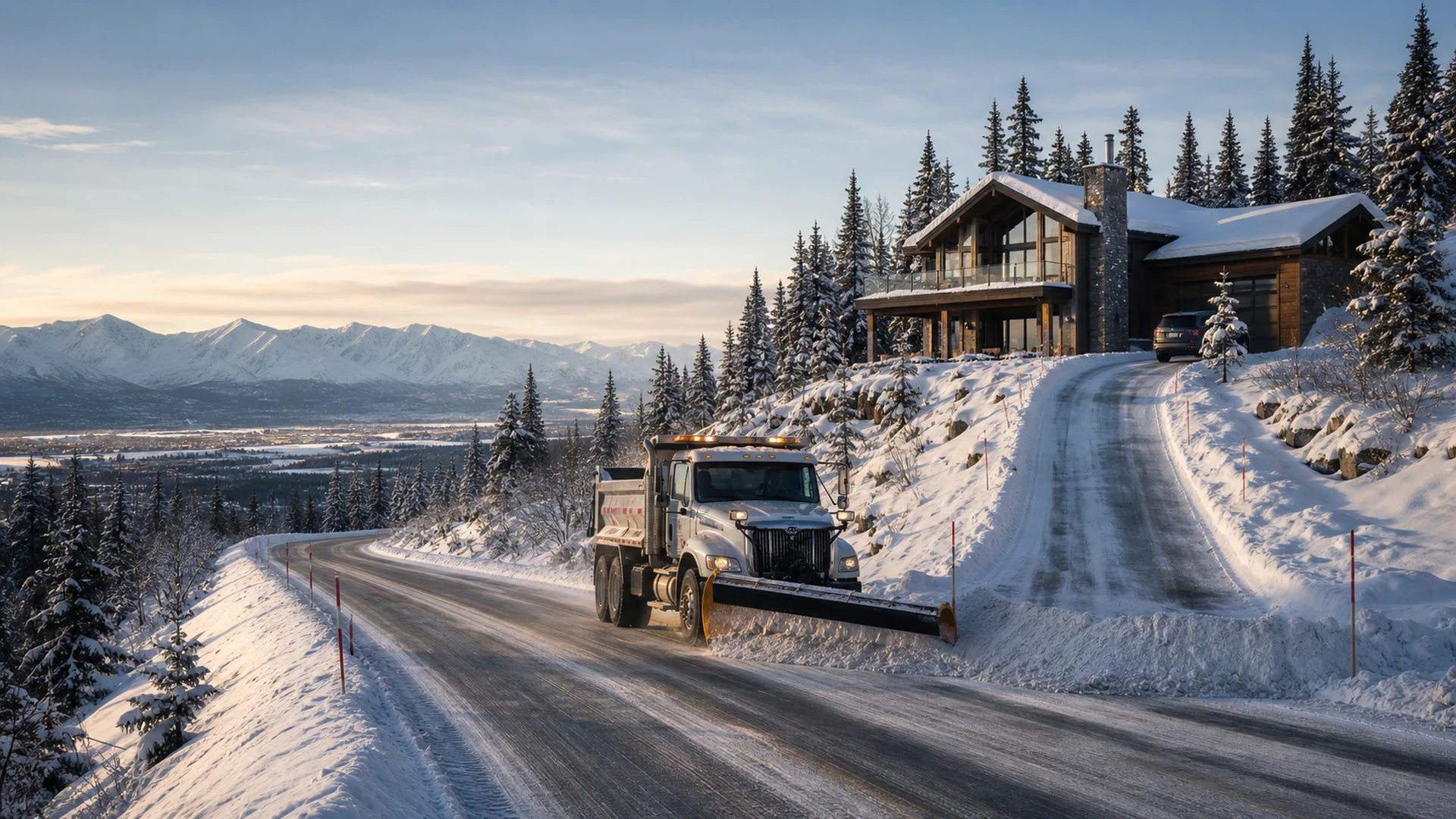
Around Anchorage, four different systems can be responsible for plowing the road to your home, and which one applies changes with the address. Inside the Anchorage Bowl, the Municipality clears arterials and collectors first, then aims to reach every residential street at least once within 84 hours of a “Plow Out.” Much of the upper Hillside sits in a Limited Road Service Area (LRSA) where a local board and a private contractor set the service level, and Eagle River, Chugiak, and Birchwood are served by their own quasi-independent unit, the CBERRRSA, which typically clears side streets within 24 hours. Major highways and some arterials are maintained by the State of Alaska DOT&PF instead. And some acreage and view homes sit on private or unmaintained roads where access, plowing, and cost-sharing depend on a recorded easement and the neighbors — something to verify before you make an offer, not after.
After four decades living in Anchorage, I have learned that buyers touring in July almost never ask the question that will define their January: who plows this road? The mountain view, the acreage, the quiet setting that sells a Hillside or Eagle River home in summer all depend on winter access that different buyers take for granted — and shouldn’t. Two homes a mile apart can sit in completely different maintenance systems, with completely different plow timelines and completely different out-of-pocket costs.
This guide walks through the four systems that can apply near Anchorage, what each one actually delivers, and the specific things I check on a listing before a client ever writes an offer. It is written from local experience and grounded in the Municipality of Anchorage, State of Alaska DOT&PF, and lending sources cited at the end.
- In the Anchorage Bowl, the Municipality clears arterial and collector streets first, then targets every residential street at least once within 84 hours of a declared “Plow Out.”
- The Municipality’s standard trigger is a snowfall of 4 inches or greater; if a new 4-inch event hits mid-plow-out, residential plowing stops and crews return to the main roads first.
- Much of the upper Hillside lies in a Limited Road Service Area (LRSA) — roughly twenty-one of them — each with a locally elected board and a private contractor that set the service level.
- Eagle River, Chugiak, and Birchwood are served by the CBERRRSA, a quasi-independent unit that dispatches at about 2 inches on main routes and clears side streets within 24 hours after 4 inches.
- Across every system, clearing the driveway berm and your own driveway is the property owner’s responsibility, not the plow crew’s.
- The State of Alaska DOT&PF maintains the major highways and several Hillside arterials (O’Malley, Huffman, DeArmoun, Rabbit Creek, Hillside Drive), not the Municipality.
- On a private road, financing usually hinges on a recorded permanent easement and all-weather access — and, for some loan programs, a road maintenance agreement.
Who Actually Plows Your Road Near Anchorage?
The single most useful thing a buyer can do is stop assuming “the city” plows every road. Around Anchorage, responsibility splits across four systems, and the boundary between them is not always obvious from the curb. Here is the framework I use.
1. The Anchorage Bowl (ARDSA). Most streets inside the Anchorage Bowl fall within the Anchorage Roads and Drainage Service Area, maintained by Municipal Street Maintenance. Per the Municipality of Anchorage, after a snowfall of 4 inches or greater, crews first clear arterial and collector streets, trails, and priority sidewalks; once the mains are done a “Plow Out” is declared with the goal of reaching every residential street at least once within 84 hours. The Municipality reports it maintains roughly 1,281 lane miles of roads. Unlike a private drive, this service is funded through your property tax — but it also runs on a priority order you don’t control.
2. The Hillside LRSAs. This is the one that surprises transplants most. Per the Municipality, Limited Road Service Areas are established by the Anchorage Assembly under Municipal Code Title 27 to provide limited road maintenance for rural roads on the Hillside, and there are about twenty-one individual service areas serving the Hillside. Each has a locally elected board of supervisors, and all road work is carried out by private contractors selected by competitive bid, with each area keeping its own separate fund. In practice that means the plow standard on your street is set by your LRSA board and its contractor — not by a citywide rule — so it genuinely varies from one Hillside road to the next.
3. Eagle River, Chugiak & Birchwood (CBERRRSA). These communities are covered by the Chugiak-Birchwood-Eagle River Rural Road Service Area, which the Municipality describes as encompassing over 350 lane miles and which was formed in 1985. It operates as a quasi-independent unit with its own budget, foreman, and contractor, advised by a board drawn from local community councils. Per the CBERRRSA, contract crews are dispatched to main and collector routes after about 2 inches of accumulation, and remaining side streets are plowed after 4 inches, completed within 24 hours of dispatch.
4. State of Alaska roads (DOT&PF). The State maintains the major highways and several arterials that Anchorage buyers assume are “city” roads. Per the Municipality’s own list, state-maintained roads include the Glenn Highway, the New and Old Seward Highway, and Hillside routes such as O’Malley Rd, Huffman, DeArmoun Rd, Rabbit Creek Rd, and Hillside Dr. Alaska DOT&PF’s Central Region runs its own winter-maintenance priority tiers and an online priority map.
| System | Where it applies | Snow trigger | Residential / side-street target |
|---|---|---|---|
| ARDSA (Municipality) | Anchorage Bowl | 4″ or greater | Every residential street ≤ 84 hours (Plow Out goal) |
| LRSA | Anchorage Hillside (~21 areas) | Set locally | Varies by service area and contractor |
| CBERRRSA | Eagle River / Chugiak / Birchwood | ~2″ mains; 4″ side streets | Side streets ≤ 24 hours after dispatch |
| State (DOT&PF) | Highways & major arterials | Priority-tier based | Cleared by winter priority tier |
| Private road | Some acreage / view lots | Owner-arranged | No public service — owner / neighbor responsibility |
How Fast Does Anchorage Actually Plow Residential Streets?
The honest answer is: it depends on the winter, and the 84-hour goal is a goal, not a guarantee. Per the Municipality, if another snowfall greater than 4 inches occurs while crews are mid-plow-out, residential plowing stops and crews return to arterials and collectors first — then resume. In a heavy snow year that cycle repeats, which is how a “three-day” expectation quietly becomes a week on a low-priority residential street.
Buyers who move here from milder cities consistently underestimate this. Unlike a place where a light dusting gets plowed by morning, the Anchorage Bowl system is deliberately built around clearing the mains and emergency routes first — a sensible public-safety order, but one that leaves your cul-de-sac waiting. It is also worth knowing that rights-of-way are reserved for snow storage in winter and can extend seven or more feet beyond the road edge, per the Municipality, which is why plow berms and pushed-back snow end up where they do.
Why Does Eagle River Get Cleared Faster — and What’s the Catch?
The CBERRRSA is a genuinely different model, and it’s one of the reasons some buyers gravitate to Eagle River. Because the service area is locally governed with its own budget and contractor, and because it targets side streets within 24 hours, plow-outs there are often quicker than in the larger Bowl system. Local reporting and the road board have noted that the arrangement has historically come with a lower dedicated street-maintenance mill rate than the main Municipality as well — though tax rates are set annually and shift, so treat any specific figure as a snapshot to verify for the current year, not a permanent number.
The catch is the berm. As the CBERRRSA board has made explicit, clearing all driveway and mailbox snow berms is the sole responsibility of each property owner. Faster plowing means the plow reaches your street sooner — and leaves a berm across your driveway sooner. On a long or steep Eagle River Valley driveway, that is a real, recurring winter chore, not a one-time cost.
What Should You Check on a Private or Unmaintained Road?
Plenty of the most desirable acreage and view homes near Anchorage sit on private or unmaintained roads — and that’s fine, as long as you understand what you’re taking on. The Municipality is clear that where an area can’t meet the basic criteria for a road service area, owners must fund their own maintenance, often through a homeowners’ association or informal group. There is no public plow coming.
What can make a private road work
- A recorded, permanent easement or right-of-way to a public road
- An all-weather surface passable by cars and emergency vehicles year-round
- A clear, written cost-sharing arrangement among the owners who use it
- Privacy and setting a maintained subdivision can’t offer
What to watch for
- No recorded access, or access that doesn’t “run with the land”
- Neighbors who won’t sign a maintenance agreement your lender needs
- Steep grades that raise plowing and sanding cost
- An unbudgeted annual bill for snow removal and summer grading
Will a Private Road Affect My Mortgage in Alaska?
It can, and it’s a conversation to have with your lender before you write the offer — not during underwriting. Requirements differ by loan program. According to guidance across major programs: Fannie Mae generally wants a legally enforceable maintenance agreement or covenant when a home fronts a community- or privately-owned street; Freddie Mac typically does not require a signed agreement if there is a permanently recorded easement for ingress and egress; and both the FHA and, per VA Circular 26-22-17 effective November 25, 2022, the VA now generally accept a recorded permanent easement rather than a separate maintenance agreement. Nearly every program also requires the road to be an all-weather surface a passenger car and emergency vehicle can use at all times.
The practical failure mode I want clients to avoid: falling for a home, then discovering at day 20 of escrow that the access easement was never recorded, or that a neighbor won’t sign the agreement a particular loan needs. Where a lender’s product creates friction, an experienced local loan officer can sometimes match the file to a program whose access rules fit the property — but that only works if you start early.
This information is general and educational, not legal, tax, or financial advice. Loan-program rules and lender overlays change and vary by property and borrower — confirm requirements with a licensed lender, and confirm recorded access with a title company or attorney before relying on it.
How Do I Verify All of This Before I Buy?
Here is the short due-diligence sequence I run on any Anchorage-area home where winter access is a question:
1. Pin the service area. Use the Municipality of Anchorage’s street ownership and maintenance maps to see whether the road is ARDSA, an LRSA, CBERRRSA, State-owned, or none of these. Ownership and maintenance can even differ by season on some roads, so check both.
2. Call the right dispatch. For Bowl questions, Anchorage Street Maintenance; for Eagle River, the CBERRRSA / Eagle River Street Maintenance; for a state route, DOT&PF Central Region. Each can tell you how a specific road is actually serviced.
3. Read the access documents. On a private road, confirm a recorded permanent easement to a public road, and find out who plows, how costs are split, and whether there’s an association or agreement.
4. Budget the driveway. In every public system the berm and driveway are yours. Price a snowblower or a seasonal plowing contract into the true cost of the home — particularly on a long, steep, or view-lot drive.
- Municipality of Anchorage — Street Maintenance / Winter Maintenance: the 4-inch trigger, the “Plow Out” declaration, the 84-hour residential goal, arterial/collector priority order, snow-storage rights-of-way, and the list of State-maintained roads (Glenn, Seward, O’Malley, Huffman, DeArmoun, Rabbit Creek, Hillside Dr).
- Municipality of Anchorage — Road Maintenance Service Areas (LRSA/RRSA): LRSAs established under AMC Title 27, ~21 Hillside service areas, locally elected boards, competitive-bid private contractors, separate funds; and criteria for areas that must self-fund maintenance.
- Municipality of Anchorage — CBERRRSA (Chugiak-Birchwood-Eagle River Rural Road Service Area): 350+ lane miles, formed 1985, ~2″ dispatch on mains and 4″/24-hour side-street standard, and the owner-responsibility berm policy.
- Alaska DOT&PF — Statewide/Central Region Maintenance & Operations and Winter Road Maintenance Priority Map (state highway maintenance and winter priority tiers).
- Lending / GSE guidance (Fannie Mae, Freddie Mac, FHA, and VA Circular 26-22-17) on private-road access, recorded easements, all-weather surfaces, and revised maintenance-agreement rules.
- Anchorage Daily News — reporting on CBERRRSA governance, local road maintenance budgets, and Eagle River plow-out timing relative to the Anchorage Bowl.
Note on specifics: service-area boundaries, contractors, budgets, and tax mill rates are set locally and change year to year. Treat any dated figure here as a snapshot to confirm for the current season and address; the systems and responsibilities described are the durable part.
Buying — or selling — where winter access matters?
I check the road, the service area, and the access documents before my clients ever write an offer. Let’s make sure the home works in January, not just July.
Frequently Asked Questions
In the Anchorage Bowl, the Municipality clears arterial and collector streets first, then declares a “Plow Out” with a goal of reaching every residential street at least once within 84 hours. If another snowfall of 4 inches or more hits mid-plow-out, crews stop residential work and return to the main roads first, so heavy snow years can stretch the timeline. Eagle River’s separate service area typically clears side streets within 24 hours of dispatch.
Much of the upper Hillside sits inside a Limited Road Service Area (LRSA), not the main city plow system. There are about twenty-one individual LRSAs on the Hillside, each with a locally elected board that hires a private contractor by competitive bid and controls its own budget. Because service levels are set locally, plowing speed, sanding, and road condition can differ from one LRSA to the next — always confirm which one a home is in.
Eagle River, Chugiak, and Birchwood are served by the Chugiak-Birchwood-Eagle River Rural Road Service Area (CBERRRSA), a quasi-independent unit within the Municipality with its own budget, foreman, and contractor. Crews are dispatched to main and collector routes after about 2 inches of accumulation, and side streets are cleared within 24 hours after 4 inches. The trade-off is that clearing the driveway berm the plow leaves behind is entirely the property owner’s responsibility.
A berm is the ridge of compacted snow a passing plow pushes across the end of your driveway. Across the Anchorage area — the city, the Hillside service areas, and Eagle River’s CBERRRSA — clearing that berm and your driveway is the property owner’s responsibility, not the plow crew’s. On a long, steep, or view-lot driveway, that means budgeting for a snowblower or a private plowing contract every winter.
It depends on your loan program and the property, so confirm with your lender early. Fannie Mae generally wants a legally enforceable maintenance agreement or covenant when a home fronts a privately owned street; Freddie Mac and, since November 2022, FHA and VA typically accept a recorded, permanent easement or right-of-way to a public road instead of a signed agreement. Nearly all programs require all-weather access a passenger car and emergency vehicle can use year-round. This is general information, not legal or lending advice — verify with a licensed lender.
The State of Alaska DOT&PF maintains the major highways and many arterials — including the Glenn and Seward highways and roads such as O’Malley, Huffman, DeArmoun, Rabbit Creek, and Hillside Drive — while the Municipality maintains most local Bowl streets. Ownership can even flip by season on some roads. If a home relies on a state route for access, DOT&PF’s Central Region and its winter-maintenance priority map show how quickly that road is cleared.
Not necessarily — many desirable acreage and view homes near Anchorage sit on private or unmaintained roads. The key is to go in with eyes open: confirm a recorded permanent easement for legal access, verify who actually plows and how costs are shared, check that access is all-weather, and budget for private snow removal. Problems arise when buyers assume the city plows a road it does not, or discover late in escrow that there is no recorded access.