

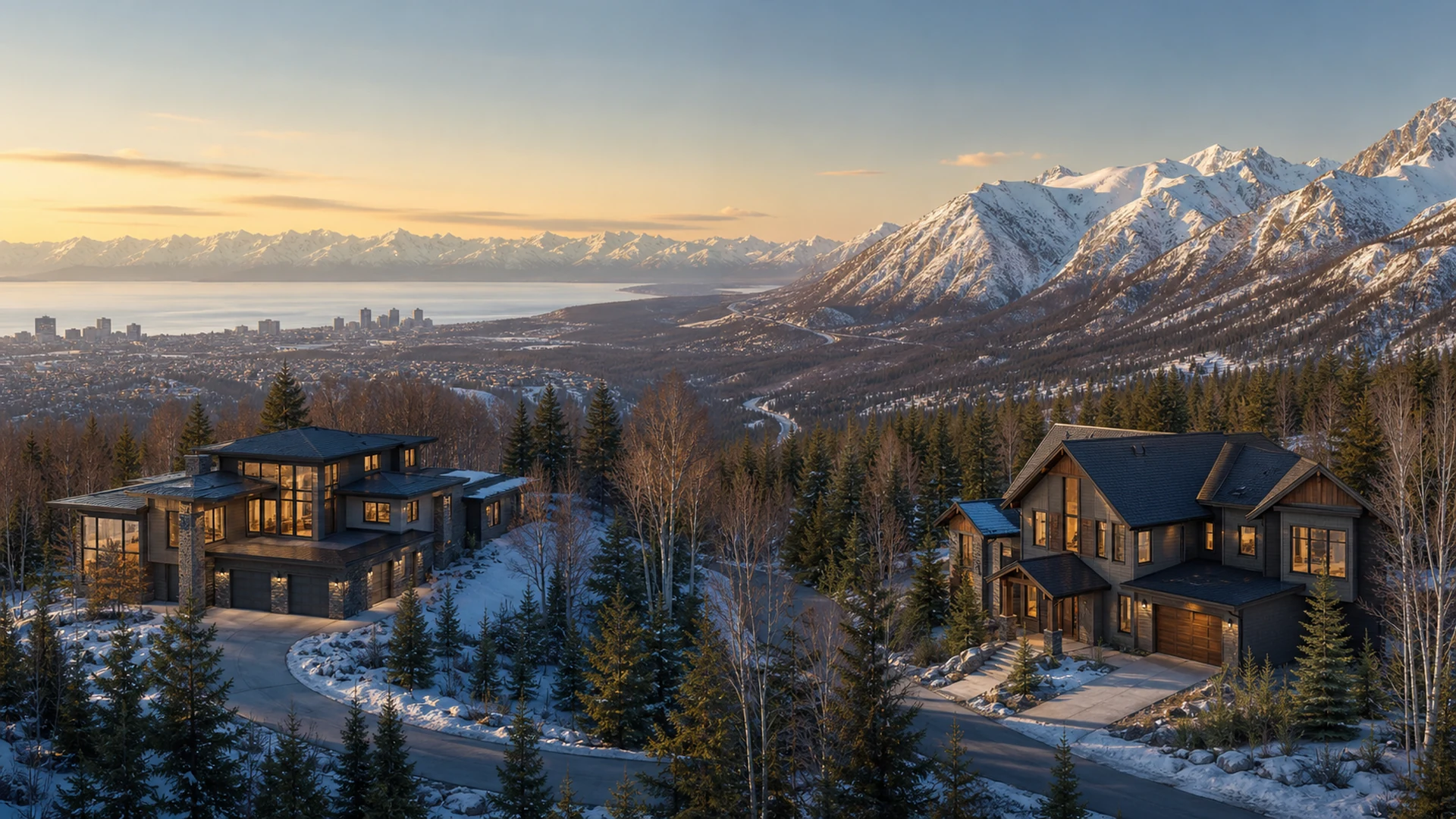
The Hillside and Eagle River are both inside the Municipality of Anchorage, but they solve for different priorities. The Hillside, perched on the Chugach foothills, offers the area’s highest luxury ceiling, large wooded view lots facing Cook Inlet and the Alaska Range, and in-city commutes — with many homes on private well and septic and some steep, icy winter streets. Eagle River sits about 15 miles north in its own valley, trading some price and lot acreage near town for a distinct small-town feel, fast Chugach State Park trail access, and a mix of newer construction — reached via the Glenn Highway, which typically takes 15 to 30 minutes but can slow or close in snow. Choose the Hillside for maximum views, acreage, and prestige inside the city; choose Eagle River for value, newer homes, and a valley lifestyle.
When buyers ask me to compare Anchorage’s Hillside with Eagle River, they usually think it’s a price question. It rarely is. After four decades living in this town, what I’ve watched play out again and again is that the two areas attract people who want fundamentally different daily lives — and the smartest buyers figure out which life they’re actually buying before they fall for a specific house. This guide lays the two areas side by side on the factors that matter most, with the local due-diligence details (well and septic rules, winter access, view orientation) that generic listing sites tend to skip.
- Both areas are inside the Municipality of Anchorage and served by the Anchorage School District — a key reason Eagle River is often weighed against Wasilla rather than against Anchorage proper.
- Hillside East listings commonly span the mid-$500,000s to over $2,000,000; Eagle River’s median runs lower, with most active listings roughly $375,000–$625,000.
- The Hillside is known for large wooded lots (often one to several acres); Eagle River lots near town tend to be half an acre or smaller, with larger parcels up Eagle River Road, Hiland Road, and newer subdivisions.
- Eagle River is about 15 miles north of downtown, typically a 15–30 minute Glenn Highway drive; the Hillside stays in-city but includes steep, icy neighborhood streets.
- Any home on private well and/or septic in either area needs a Certificate of On-Site Systems Approval (COSA) from the Municipality at title transfer — obtained by the seller, tested by a licensed engineer.
- Hillside views face west/southwest toward Cook Inlet, downtown, and the Alaska Range; Eagle River offers immersive Chugach valley and peak views.
- Eagle River buyers often underestimate valley snow accumulation; Hillside buyers underestimate wind, ice, and grade on the higher streets.
Hillside vs Eagle River at a Glance
Here is the side-by-side comparison first, so you can orient quickly — the sections below explain each row in depth. Figures are ranges reported by area sources and the Municipality of Anchorage; specific prices and drive times vary by season, inventory, and exact location.
| Factor | Anchorage Hillside | Eagle River |
|---|---|---|
| Setting | Chugach foothills within south Anchorage; semi-rural feel inside the city | Distinct valley community ~15 miles north; small-town feel |
| Typical luxury price band | Mid-$500Ks to $2M+ (Hillside East) | Most active listings ~$375K–$625K; premium pockets higher |
| Lot size | Large wooded lots, often 1–5 acres | Often ½ acre or less near town; 1+ acre up ER Rd, Hiland Rd, valley subdivisions |
| Commute to downtown | In-city; shorter when clear; steep icy streets | ~15 miles / 15–30 min via Glenn Highway; less predictable in storms |
| Views | West/SW to Cook Inlet, city, Alaska Range; winter sun | Chugach valley & surrounding peaks; inlet from higher north pockets |
| Water/sewer | Many homes on private well & septic | Mix of on-site systems and community water & sewer |
| School district | Anchorage School District | Anchorage School District |
| Recreation | Chugach trailheads (Glen Alps, Flattop), Hilltop Ski Area, Far North Bicentennial Park | Chugach State Park “out the back door,” Eagle River Nature Center, Eklutna Lake |
Price bands above are drawn from area real-estate sources and reflect ranges, not a single median. Because Anchorage-area markets shift with seasonality and inventory, the right move before you buy or list is a current, neighborhood-level comparable-sales pull for your exact criteria.
How Do Prices Compare Between the Hillside and Eagle River?
The clearest structural difference is the luxury ceiling. On the Hillside — particularly Hillside East — larger lots and view lots push prices from the mid-$500,000s to well over $2,000,000, and the area’s upper end includes true estates: I’ve seen single properties on multi-acre parcels that read more like private compounds than tract homes. Eagle River, by contrast, is where a lot of buyers find more house for the money; area sources put the median around the mid-$400,000s with most active listings clustered roughly between $375,000 and $625,000. Newer subdivisions and homes with mountain views command Eagle River’s premium, and prices there generally run higher than Wasilla but below mid-town and south Anchorage.
Unlike a simple “which is cheaper” framing, the real distinction is ceiling versus value: the Hillside is where Anchorage’s highest-end custom inventory concentrates, while Eagle River rewards buyers who want newer construction and space without paying Hillside view premiums.
Which Area Has Bigger Lots — and What Comes With Them?
The Hillside is Anchorage’s large-lot address. Its reputation is built on wooded parcels — frequently one to several acres — with mature trees, privacy, and Chugach trailheads (Glen Alps, Flattop, Prospect Heights) close by. Eagle River’s lot pattern is different: close to town, half-acre-or-smaller lots are common, while the genuinely large parcels sit farther up Eagle River Road, Hiland Road, and in newer valley subdivisions — a few of which now market 1.25-acre-plus lots as a rarity.
Here’s the part buyers miss: a bigger lot in either area is not free. Larger parcels usually mean private well and septic (with the maintenance and testing that follow), higher heating loads, and more snow to move each winter. The acreage is the reward; the systems and snow are the responsibility.
Hillside — strengths
- Highest luxury ceiling and estate inventory in the area
- Large wooded, private lots with mature trees
- West/southwest Cook Inlet, city, and Alaska Range views
- In-city location; direct Chugach trailhead access
Hillside — trade-offs
- Higher entry price for view/estate lots
- Many homes on well & septic (COSA due diligence)
- Steep, wind-exposed, icy streets in winter
- Older custom stock in places may need updating
Eagle River — strengths
- More home and newer construction for the money
- Distinct small-town, valley community feel
- Chugach State Park trails essentially out the back door
- Anchorage School District; convenient to JBER
Eagle River — trade-offs
- Glenn Highway commute less predictable in storms
- Larger lots require driving up-valley
- Valley can see heavier snow accumulation
- Major hospital & specialty services are in Anchorage
What Is the Commute Really Like — Hillside vs Eagle River?
Eagle River is roughly 15 miles north of downtown Anchorage, and the drive is typically 15 to 30 minutes on the Glenn Highway — genuinely one of the easier suburban commutes in the region when the road is clear. The Hillside, being inside Anchorage, usually offers shorter and more predictable drives to Midtown and downtown on good days, though you trade that for steep neighborhood streets that ice over.
The honest difference is reliability in winter. The Glenn Highway is a single primary artery, and it can back up or close during severe weather; local reporting has documented snow-day mornings with dozens of crashes and periodic diversions of traffic through Eagle River when the highway is closed. That doesn’t make Eagle River a bad choice — it makes it a choice where I tell buyers to actually drive their real work route, at their real commute times, in winter, before they commit. For live conditions, the Alaska DOT&PF 511 system is the authoritative source.
Which Area Wins on Views and Winter Sun?
This is where the Hillside earns its reputation. Because it sits on the western slope of the Chugach, its homes face west and southwest — toward Cook Inlet, the Anchorage skyline, Sleeping Lady (Mount Susitna), and, on clear days, Denali and the Alaska Range. That orientation also means many Hillside lots capture genuine winter sun, which in a high-latitude town is a livability factor, not a luxury. Eagle River’s scenery is different in character: tucked into its valley and ringed by Chugach peaks, it delivers immersive mountain views, with inlet views available from higher pockets and South Fork.
The buyer’s lesson I repeat constantly: a “view lot” is not one thing. On the Hillside especially, orientation and grade determine whether you get low winter sun or a shadowed north face — and that’s worth checking on a site visit, not assuming from a listing photo.
What Should You Check on Well and Septic in Either Area?
This is the most important due-diligence item that trips buyers up, and it applies to both areas because both are inside the Municipality of Anchorage. Per the Municipality’s On-Site Water and Wastewater Section, a Certificate of On-Site Systems Approval (COSA) is required at title transfer for single-family homes and duplexes served by a private well and/or on-site septic system — a requirement in place since a 1998 Municipal Assembly ordinance. The seller is responsible for obtaining it, and a licensed civil engineer must inspect and test the systems.
What that testing involves, in practical terms: an engineer performs a well flow test and a septic absorption-field adequacy test (each generally valid for two years), collects water samples for bacteria and nitrates (results typically valid ~90 days) and arsenic (~1 year), and the Municipality requires a septic-tank pumping receipt within the past year. Per the Municipality’s standards, wells serving three or fewer dwelling units draw an advisory if sustained production falls below 150 gallons per day per bedroom. A COSA-processing fee is charged by the Municipality — roughly $600 per current engineering-firm guidance — on top of the engineer’s testing cost. Many Hillside homes are on well and septic; Eagle River is a genuine mix of on-site systems and community water and sewer, so confirm which you’re buying.
Because ground must be unfrozen to run absorption-field testing, well-and-septic timing is a seasonal logistics factor. If a system fails, a new one may need to be designed, permitted, and installed — a costly, time-consuming process; in winter the Municipality can issue a conditional COSA with an escrow set well above the highest repair bid. Testing early in the selling process is the way to avoid a failed sale.
So — Hillside or Eagle River? Choosing Your Fit
Choose the Hillside if your priorities are maximum views, large private acreage, winter sun, and Anchorage’s highest-end custom inventory — and you’re comfortable with a higher entry price, well-and-septic ownership, and steep winter streets. Choose Eagle River if you want more home and newer construction for the money, a genuine small-town valley community, trails out the back door, and you can live with a Glenn Highway commute that’s usually quick but occasionally weather-dependent. Both keep you in the Anchorage School District and both put world-class Chugach recreation within minutes — so this is less “better vs worse” and more “which daily life fits yours.”
- Municipality of Anchorage, On-Site Water & Wastewater Section — COSA requirement at title transfer, seller responsibility, and engineer testing (muni.org).
- Anchorage Municipal Code Ch. 15.55 (Water Wells) & 15.65 (Wastewater Disposal) — well yield advisory threshold (150 gpd/bedroom), septic tank capacity, COSA definitions.
- Alaska DEC / 18 AAC 72 & 18 AAC 80 — state wastewater and drinking-water regulations referenced by MOA code.
- Alaska DOT&PF 511 (511.alaska.gov) — live Glenn Highway conditions and winter closures.
- Anchorage Police Department / Anchorage Daily News / Alaska’s News Source — documented Glenn Highway winter closures and crash counts (2025–2026).
- Anchorage School District — both areas served by ASD (attendance boundaries verifiable by address).
Still Deciding Between the Hillside and Eagle River?
I’ll pull current comparables for both and help you test-drive the trade-offs before you commit.
Frequently Asked Questions
The Hillside generally carries the higher luxury ceiling. Hillside East listings commonly range from the mid-$500,000s to over $2,000,000, driven by view lots and large custom estates. Eagle River’s median sits lower, with most active listings roughly between $375,000 and $625,000, though higher-elevation and newer custom homes there command a premium. Exact figures shift with season and inventory, so ask for current comparable sales before pricing your search or your home.
Eagle River sits about 15 miles north of downtown Anchorage, typically a 15 to 30 minute drive on the Glenn Highway. The Hillside is inside Anchorage proper, so most downtown and Midtown drives are shorter when roads are clear. The bigger difference is reliability: the Glenn Highway can back up or close during snow and ice events, while Hillside commutes stay in-city but include some steep, icy neighborhood streets.
If a home is served by a private well and/or on-site septic system, yes. The Municipality of Anchorage requires a Certificate of On-Site Systems Approval (COSA) at title transfer for single-family homes and duplexes on on-site systems, and Eagle River is inside the Municipality, so the same rule applies. Many Hillside homes are on well and septic; Eagle River is a mix of on-site systems and community water and sewer. The seller is responsible for obtaining the COSA.
Both offer acreage, but in different patterns. The Hillside is known for large wooded lots, with many estate parcels of one to several acres on the Chugach foothills. Eagle River lots close to town tend to be half an acre or smaller, with larger one-acre-plus parcels found up Eagle River Road, Hiland Road, and in newer valley subdivisions. If maximum acreage with in-city access is the goal, the Hillside usually wins; Eagle River trades some lot size for a valley setting and faster access to Chugach State Park trails.
Yes. Both the Hillside and Eagle River are inside the Municipality of Anchorage and are served by the Anchorage School District, not the Mat-Su Borough School District. This is one reason many buyers weigh Eagle River against Wasilla rather than against Anchorage. School attendance boundaries can change, so verify the current assigned schools for any specific address with the district.
It depends on the view you want. Hillside homes face west and southwest toward Cook Inlet, downtown Anchorage, and the Alaska Range, so many capture sweeping inlet and city panoramas plus winter sun. Eagle River sits in a valley ringed by the Chugach, so its views lean toward dramatic surrounding peaks and, from higher pockets, the inlet to the north. For classic Cook Inlet sunset views, the Hillside has the edge; for immersive mountain-valley scenery, Eagle River is hard to beat.
Both see real Alaska winters, but each has its own challenge. The Hillside’s elevation on the Chugach foothills can bring more wind, ice, and steep icy streets that reward studded tires and all-wheel drive. Eagle River buyers often underestimate that the valley can receive more snow accumulation than parts of Anchorage proper, which affects snow removal routines and Glenn Highway travel. In both areas, plan for winter tires and a snow-management strategy for the driveway.