

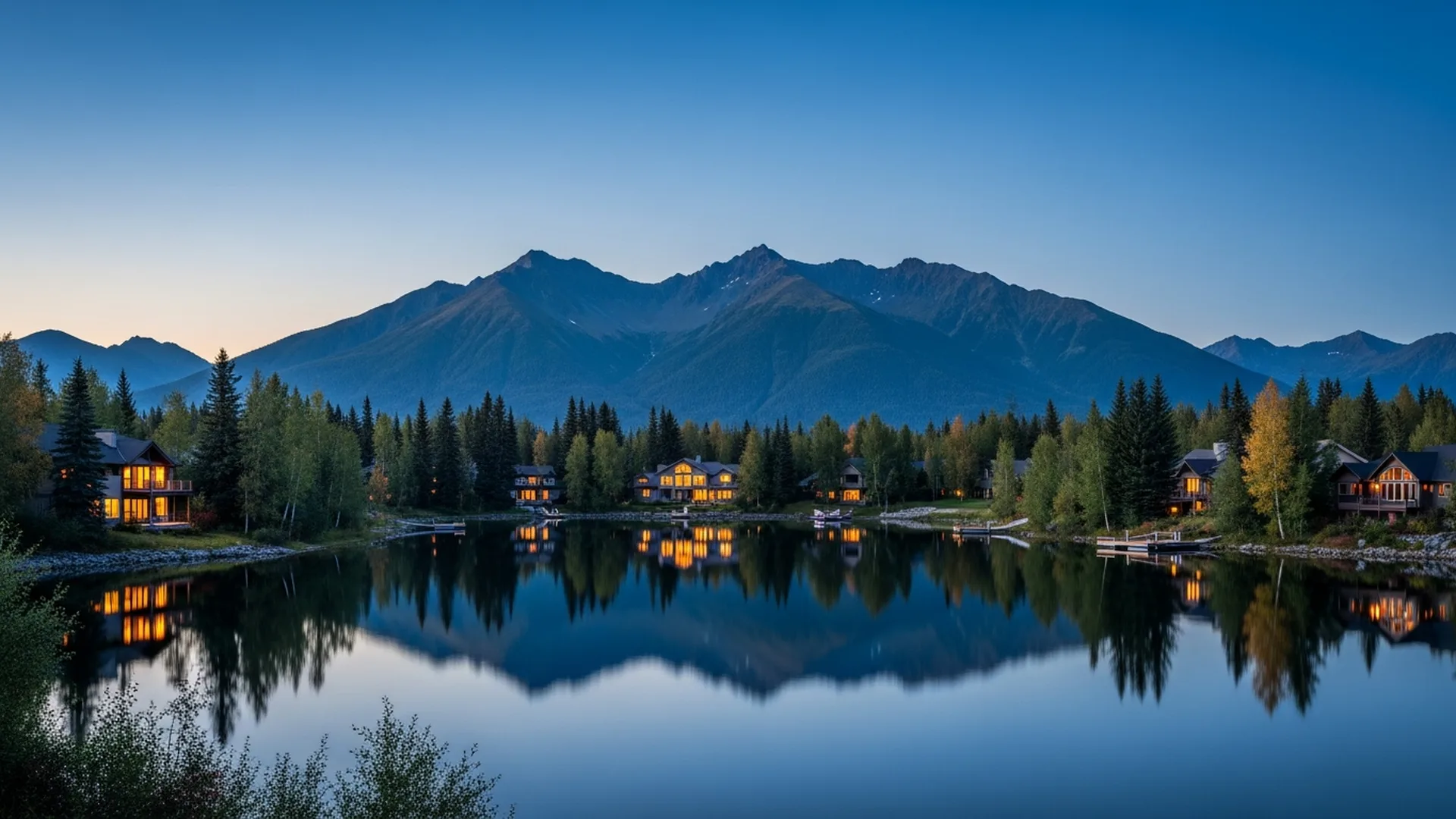
Hideaway Lake is a small, private lakefront neighborhood on the south side of the Anchorage Hillside, in the Hillside East area of Anchorage, Alaska. It is best known as a ring of custom single-family homes — commonly described as about 13 — built on spacious wooded lots around their own private lake, near the base of the Chugach front and Chugach State Park. Homes here are larger custom builds, most on private well and septic, which means a Certificate of On-Site Systems Approval (COSA) is required to transfer title. What makes the enclave rare in Anchorage is the combination of genuine lake frontage, forested privacy, and Hillside elevation; what makes it hard to buy is that so few homes ever come to market.
Anchorage has plenty of homes that overlook water and plenty that back up to the mountains, but very few that sit on a private lake of their own. Hideaway Lake is one of that short list. Having watched the Hillside develop for forty years as a local, I can tell you the enclave draws a specific kind of buyer — someone who has usually toured the big view lots first and then realized what they actually want is water at the door and trees around the house. That trade, view for privacy and lakefront, is the whole story of this neighborhood.
This profile covers what Hideaway Lake actually is, how its views and light work on the Hillside slope, the well-and-septic realities that govern nearly every sale up here, winter access, and how value is set in a market this small. Prices, availability, and specific lots change constantly, so the goal here is durable local truth you can act on, not a listing sheet.
- Hideaway Lake is a small private-lake enclave on the Anchorage Hillside, within the Hillside East area of Anchorage (ZIP 99507), reached off the O’Malley Road and Hillside Drive corridor.
- The neighborhood is commonly described as roughly 13 custom single-family homes on spacious wooded lots ringing a private lake, most originally built from the late 1970s onward and widely updated since.
- The defining amenity is lake frontage and forested privacy; open Cook Inlet and city panoramas vary lot by lot because of mature trees and the slope, so sightlines must be checked per property.
- Most Hillside East homes here are on private well and septic, which triggers Anchorage’s Certificate of On-Site Systems Approval (COSA) — required to transfer title since a 1998 ordinance.
- The Municipality of Anchorage charges $600 to review and issue a COSA; a licensed civil engineer performs a well flow test, a septic adequacy test, and water sampling for bacteria, nitrates, and arsenic.
- Because this stretch of Hillside faces roughly west toward Cook Inlet, homes catch afternoon and long summer-evening light; the Chugach front rises to the east behind the enclave.
- The surrounding Hillside East submarket showed a median sale price around $890,000 to $932,000 in 2025–2026 (Homes.com); lakefront rarity at Hideaway Lake can price above that area norm.
Where Exactly Is Hideaway Lake on the Anchorage Hillside?
Hideaway Lake sits on the south side of the Anchorage Hillside, addressing off Hideaway Lake Drive in the Hillside East neighborhood (ZIP 99507). Geographically, this is the sloped bench of ground that climbs eastward from the O’Malley Road and Hillside Drive corridor toward the wall of the Chugach. Anchorage as a whole is boxed in by water and mountains — the Chugach Mountains to the east, Turnagain Arm of Cook Inlet to the south, and Knik Arm to the north and west — and the Hillside is the elevated eastern edge of that bowl.
The Chugach front here isn’t distant scenery; it’s the back fence. Hillside East is described as a picturesque neighborhood at the base of the Chugach Mountains, characterized by custom-built homes set amid dense evergreens and larger lots, which is exactly the setting Hideaway Lake occupies. The Glen Alps trailhead into 495,000-acre Chugach State Park — the jumping-off point for Flattop Mountain, the most-climbed peak in Alaska — is reached just uphill via O’Malley Road, Hillside Drive, and Upper Huffman Road. Far North Bicentennial Park’s roughly 4,000 acres of trails and Hilltop Ski Area are also nearby. Unlike a downtown or midtown address where amenities are dense but views are limited, an enclave like this trades walk-to-everything convenience for wilderness at the doorstep and a five-mile drive to groceries and restaurants.
| Orientation fact | Detail |
|---|---|
| West / downhill | Cook Inlet & downtown Anchorage; sunset light; city & inlet sightlines (lot-dependent) |
| East / uphill | Chugach front & Chugach State Park; Glen Alps / Flattop trailhead ~2,200 ft |
| Access | Seward Hwy → O’Malley Rd → Hillside Dr → Hideaway Lake Dr |
| Setting | ~13 custom homes on wooded lots around a private lake; mostly well & septic |
| Distance to services | Groceries & restaurants roughly 5 miles downhill |
What Kind of Homes Are on Hideaway Lake?
This is a small, finite neighborhood — commonly described as about 13 single-family homes tucked around a private mountain lake on spacious wooded lots. The core housing stock originated from the late 1970s into the 1980s, with the last homes built out in the later 1990s, and most have since been updated and remodeled with modern fixtures. Floor plans run large: many homes fall in the roughly 2,500 to 4,500 square foot range, with the largest well over 5,000, and it’s common to find extensive finished lower levels adding usable space. Smaller layouts start at three bedrooms; the bigger plans reach five and six.
The character here is custom-Alaska, not tract subdivision. Because Hillside East lots are larger and heavily treed, homes sit apart from one another with real buffer — a different feel from the tightly platted view subdivisions elsewhere on the Hillside. Buyers touring Hideaway Lake consistently notice that the lake, not the neighbor’s roofline, is the thing outside the window.
What Draws Buyers Here
- Genuine private lakefront — rare anywhere in Anchorage
- Large, wooded, private lots with real separation between homes
- Custom, larger floor plans with room to update
- Chugach State Park trails and Hillside recreation minutes away
- West-facing slope catches long summer-evening light
What to Weigh Carefully
- Very few sales — you often wait for the right home
- Open inlet/city views vary by lot; trees can screen them
- Well & septic (COSA) due diligence on every purchase
- Older core construction may need systems/finish updates
- Hillside driveway grade and winter ice on shaded approaches
Which Way Do Hideaway Lake Homes Face — and Do You Get the Views?
This is the question I get most on the Hillside, and it has a real answer rooted in geography, not marketing. Anchorage sits at about 61.15°N latitude. Cook Inlet and downtown lie to the west and northwest of Hideaway Lake, and the Chugach rise to the east. So the value-carrying sightlines — city lights and inlet water — are the west-facing ones, and they come with sunset and the marathon-long summer evenings. On the summer solstice Anchorage gets roughly 19 hours of daylight and the midday sun climbs only to about 52 degrees; on the winter solstice it’s about 5.5 hours and the sun barely clears the horizon at around 5 degrees, keeping light low and golden all day. That low winter arc is why a west or southwest exposure matters here — it’s the difference between a home that catches usable winter light and one that sits in slope shadow by early afternoon.
The honest caveat: Hideaway Lake’s signature isn’t a wide-open panorama the way a bare view lot higher up the Hillside is. It’s a lake enclave in the trees. Some lots pull real inlet and city views through cleared sightlines; others trade the distant view for water and forest right at the house. Neither is “better” — they’re different products, and the price should reflect which one a given home actually delivers. Evaluate the sightline in person, ideally in winter when the trees are bare and the sun is low, because that’s when a view either holds up or doesn’t.
Are Hideaway Lake Homes on Well and Septic — and What Is a COSA?
Yes — like most of Hillside East, Hideaway Lake homes are served by private wells and on-site septic systems rather than public water and sewer. That single fact governs nearly every transaction up here, so it deserves real attention. Since a Municipal Assembly ordinance passed in August 1998, the Municipality of Anchorage requires a Certificate of On-Site Systems Approval (COSA) in order to transfer title on any property served by a well or septic system. The purpose, per the MOA, is to confirm the septic is functional and not a health hazard and that the well water is safe to drink and adequate in quantity for the household.
Here’s how the process actually runs. A licensed civil engineer researches MOA records, performs a field inspection, and runs the tests: a well flow test (often a four-hour test to calculate production), a septic adequacy test where water is added to the absorption field and must absorb over a 24-hour period, and water sampling for bacteria, nitrates, and arsenic. Bacteria and nitrate samples are only valid for 90 days; arsenic samples for one year; the overall test is generally good for two years. The Municipality charges $600 to review the paperwork and issue the COSA, on top of the engineer and lab fees. If the system passes but needs minor repairs — a new sanitary seal, standpipe caps, extending a cutoff standpipe above grade — those get handled. If the septic fails, a replacement is designed, permitted, and installed, and that is where costs climb quickly.
The surprise that catches sellers most often is bedroom count. Anchorage Municipal Code 15.65 sizes a septic system by the number of bedrooms it serves. An older home that finished a lower level and added bedrooms later can discover the original septic was only approved for fewer bedrooms than the house now advertises — a mismatch the COSA will flag. On a larger Hideaway Lake home, that’s exactly the kind of detail worth confirming before listing, not during escrow. The MOA’s On-Site Water and Wastewater Section maintains searchable records at muni.org/onsite, which is the right first stop for any specific address.
Per one Anchorage brokerage’s figures, in a recent year roughly 241 Anchorage homes sold with well and septic systems — mostly on the Hillside — rising to about 336 when Eagle River is included. Well-and-septic isn’t exotic here; it’s the normal way the upper Hillside is served. It just requires the right due diligence.
What About Winter Access and Driveway Grade?
Because Hideaway Lake sits on the sloped Hillside rather than the valley floor, access is a genuine factor, not boilerplate. The neighborhood is reached off the well-established O’Malley Road and Hillside Drive corridor, so getting to the neighborhood in winter is generally dependable. The variable is the last hundred feet: an individual home’s driveway pitch and orientation. A steep, north- or east-shaded driveway holds ice long after a south- or west-facing one has cleared, and that shows up as a real quality-of-life difference from October to April. It also affects what kind of snow management a buyer should budget for.
Two practical checks I recommend on any upper-Hillside home: confirm who maintains the road serving the property (Municipality-maintained versus a private or limited-service road association), and walk the driveway grade in person. Those two answers tell you more about living here through a real Anchorage winter than any summer showing will.
Thinking of Selling at Hideaway Lake? What Drives Value Here
In a neighborhood of only around 13 homes, value is set by scarcity and by the specific attributes of your property rather than by a busy comparable-sales stream. The Hillside East submarket around Hideaway Lake showed a median sale price roughly in the $890,000 to $932,000 range in the 2025–2026 window per Homes.com, with area homes historically moving relatively quickly, but a true lakefront property in a finite enclave can command a premium above the area norm because there is simply nothing else like it on the market most of the time.
The levers that move your number: the quality and clarity of your inlet and city sightlines (a cleared, maintained view outperforms a screened one), lake frontage and how usable it is, lot size and privacy, and how current the home’s systems and finishes are. This is where my background helps — I pair a degree in Interior Design with a career in furnishings, design, and real estate, so I read which updates actually return value in a cold-climate custom home and which are cosmetic spend. And on the mechanics: get your well and septic tested early, because a clean COSA in hand removes the single most common cause of a delayed or lost Hillside closing. When you’re ready, the fastest path to a real number is a custom valuation on your Hillside home’s value.
- Municipality of Anchorage — On-Site Water & Wastewater Section, Certificate of On-Site Systems Approval (COSA): title-transfer requirement since the August 1998 ordinance, testing standards, bedroom-based septic sizing (AMC 15.65), and records at muni.org/onsite.
- Municipality of Anchorage — On-Site Systems Maintenance Guide (2025) and AMC 15.55 (Water Wells): well casing above-grade requirements and separation-distance rules.
- Anchorage-area civil engineering firms (COSA process providers) — the $600 MOA review/issuance fee , well flow test, septic adequacy test, and bacteria/nitrate/arsenic sampling validity windows.
- Alaska DEC — 18 AAC 72, statewide on-site wastewater regulation context (MOA administers systems serving up to two dwelling units).
- Alaska.org (Glen Alps Overlook) and Alaska DNR / Chugach State Park — Hillside geography, Glen Alps/Flattop trailhead elevation (~2,200 ft), and the 495,000-acre park.
- timeanddate.com, sunrise-sunset.org, and Alaska climate/daylight references — Anchorage latitude (~61.15°N), summer/winter solstice daylight (~19 vs. ~5.5 hrs) and midday sun altitude.
- Homes.com — Hideaway Lake and Hillside East neighborhood pages: enclave description (~13 homes on a private lake), home sizes, and Hillside East 2025–2026 median-sale-price figures (data deemed reliable, not guaranteed; via Alaska MLS IDX).
Want First Word When a Hideaway Lake Home Comes Up?
This enclave rarely lists. Work with a 40-year Anchorage local who watches the Hillside so you don’t miss it.
Frequently Asked Questions
Hideaway Lake is a private residential lake on the south side of the Anchorage Hillside, within the Hillside East area (ZIP 99507). Homes address off Hideaway Lake Drive, uphill and east of the O’Malley Road and Hillside Drive corridor, near the base of the Chugach front and Chugach State Park.
It’s a small enclave built around a private lake, commonly described as roughly 13 single-family homes on spacious wooded lots. Because it’s so small, homes come to market infrequently — which is why active availability is often zero and buyers usually watch the neighborhood over time rather than shop it on demand.
It depends heavily on the individual lot. The neighborhood’s defining feature is its private lakefront setting rather than a wide-open panorama. Homes on this stretch of the Hillside generally face west toward Cook Inlet and downtown Anchorage for sunset light, while the Chugach Mountains rise to the east behind the enclave. Mature trees and the slope mean city and inlet views vary lot by lot, so each property must be evaluated on its own sightlines — ideally in winter when the trees are bare.
Most Hillside East properties in this area, including Hideaway Lake, are served by private wells and septic systems rather than public utilities. That triggers Anchorage’s Certificate of On-Site Systems Approval (COSA). Since a 1998 Municipal Assembly ordinance, a COSA must be obtained to transfer title on any Municipality of Anchorage property served by a well or septic system, confirming the systems are safe and adequate.
A COSA (Certificate of On-Site Systems Approval) is a Municipality of Anchorage document confirming a home’s well and septic have been tested by a licensed civil engineer and meet code. The MOA charges $600 to review the paperwork and issue the certificate, on top of the engineer’s inspection and lab fees. A well flow test, a septic adequacy test, and water samples for bacteria, nitrates, and arsenic are all part of the process, and bacteria/nitrate samples are only valid for 90 days.
Hideaway Lake sits on the sloped Hillside, so driveway grade and winter maintenance matter more than in flatter parts of Anchorage. The neighborhood is reached off the established O’Malley Road and Hillside Drive corridor, so main-road access is generally reliable, but steep, shaded driveways can hold ice. Checking road-maintenance responsibility and walking the driveway pitch is standard due diligence for any upper-Hillside home.
Hideaway Lake homes are larger custom properties, historically in roughly the 2,500 to 4,500 square foot range with some larger. Because sales are so infrequent and value depends on lot, view, lake frontage, condition, and updates, there’s no reliable public list price on demand. The surrounding Hillside East submarket had a median sale price around $890,000 to $932,000 in the 2025–2026 window per Homes.com; Hideaway Lake’s lakefront rarity can price above the area norm.