

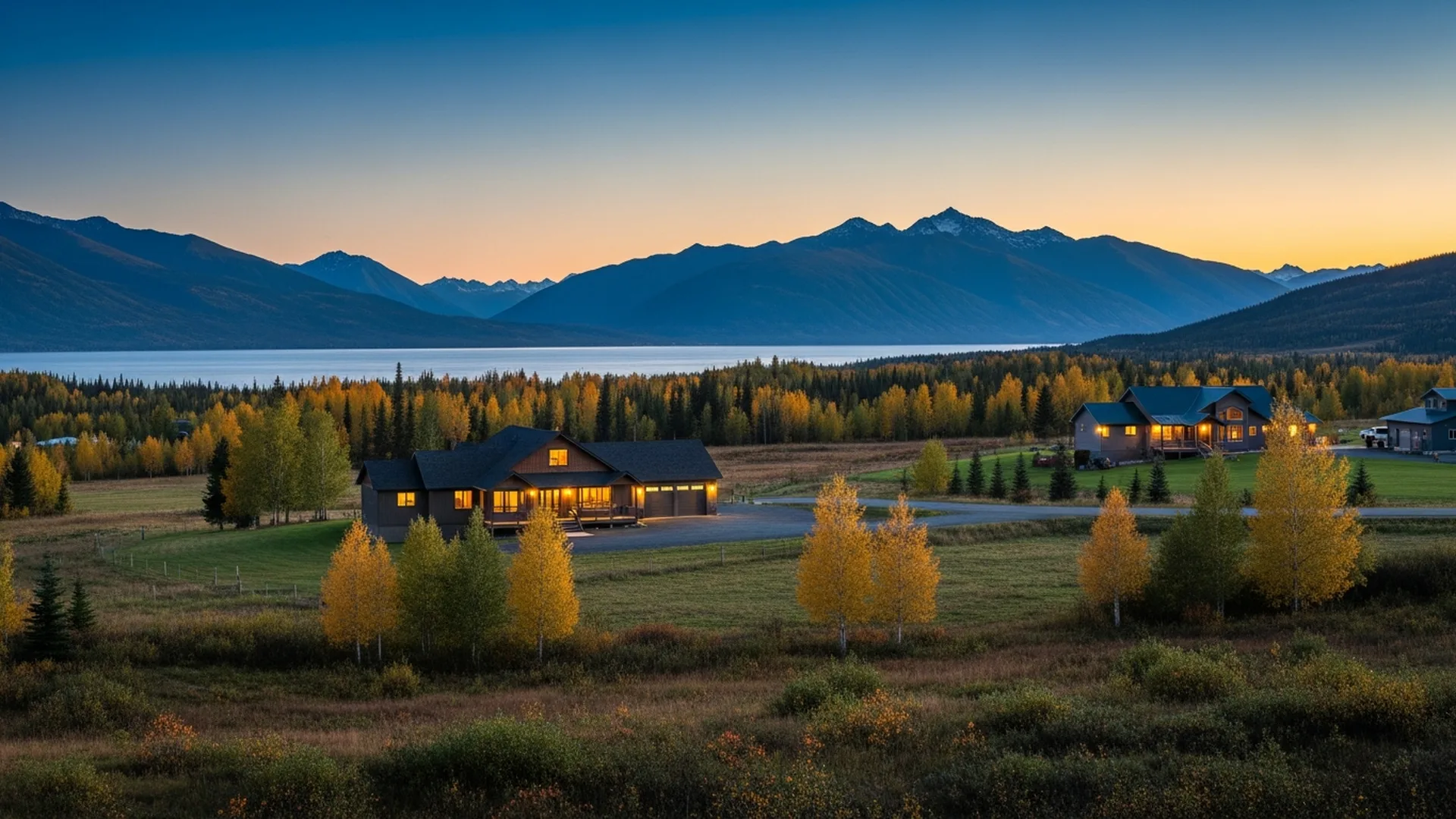
Eklutna is the northernmost residential area inside the Municipality of Anchorage, clustered near the Eklutna exit at Mile 26 of the Glenn Highway and the lower end of Eklutna Lake Road, at the foot of the Chugach Mountains. Homes here are almost always on private well and septic rather than municipal utilities, which is a core reason parcels tend to be larger — a lot must physically hold a well, a septic tank, and a drainfield while meeting Alaska DEC separation distances. Alaska State Parks places Eklutna Lake about 22 miles from Anchorage, and any home sale served by well or septic within the Municipality requires a Certificate of On-Site Systems Approval (COSA) before title transfers. For buyers who want space, mountain proximity, and a rural feel within reach of Eagle River and the Mat-Su Valley, Eklutna is one of the last acreage-oriented corners of the Municipality.
Eklutna is the kind of place people drive past on the way to somewhere else — the Eklutna exit, the turquoise glacial lake, the oldest continuously inhabited settlement in the Anchorage area. What far fewer buyers realize is that the corridor around the Old Glenn Highway and the lower reaches of Eklutna Lake Road is also a genuine residential community, and one of the last places inside the Municipality of Anchorage where acreage and a rural setting are the rule instead of a rare exception. Having watched this whole northern stretch of the Municipality fill in over four decades of living here, I’ll tell buyers the same thing every time: the appeal of Eklutna is real, but the mechanics of owning here — the well, the septic, the lot, the access — are what separate a good purchase from an expensive surprise.
This page is written for exactly that: the practical, verifiable realities of buying or selling an Eklutna-area home, sourced from the Municipality of Anchorage, Alaska DEC, Alaska State Parks, and Alaska Statutes rather than generic listing copy. Where a specific figure isn’t publicly documented — a neighborhood price series, for instance — I say so plainly rather than invent one.
- Eklutna sits at the northern edge of the Municipality of Anchorage, at the Eklutna exit at Mile 26 of the Glenn Highway; Alaska State Parks lists Eklutna Lake as about 22 miles from Anchorage.
- Homes here are typically on private well and septic, not municipal water and sewer — a primary driver of the area’s larger lot sizes.
- Alaska DEC (18 AAC 72.100) requires a private well to sit at least 100 horizontal feet from a septic tank or drainfield; 18 AAC 72.520 requires 100 feet from surface water.
- Any sale of a well- or septic-served home within the Municipality requires a Certificate of On-Site Systems Approval (COSA) before title transfers, per a 1998 ordinance; the Municipality charges $600 to issue it.
- A COSA well test includes a 4-hour flow test plus lab analysis for bacteria, nitrates, and arsenic; a COSA is generally valid two years, but water samples expire in about 90 days.
- The area is served by the Anchorage School District — nearby schools include Chugiak Elementary, Mirror Lake Middle School, and Chugiak High School.
- Under Alaska’s disclosure law (AS 34.70.010), a seller must deliver a written property disclosure before the buyer makes a written offer.
Where Exactly Is Eklutna, and How Far Is the Drive to Anchorage?
Eklutna occupies the far northern tip of the Municipality of Anchorage, reached from the Eklutna exit at Mile 26 of the Glenn Highway. The residential fabric sits near the Old Glenn Highway and the lower end of Eklutna Lake Road; from there the road narrows and winds roughly ten miles east into Chugach State Park before it dead-ends at the lake. Alaska State Parks and area guides put Eklutna Lake about 22 miles from Anchorage, and one Anchorage visitor guide estimates roughly 35 to 45 minutes from downtown in normal traffic.
The practical takeaway for a resident is that Eklutna is close in feel to the wilderness but tethered to the road system. Unlike a genuinely remote parcel, an Eklutna home is a straightforward Glenn Highway commute — south to Eagle River and Anchorage, or north into the Mat-Su Valley. You get the rural setting without giving up connectivity, which is the trade many acreage buyers are actually chasing.
| Fact | Detail | Source |
|---|---|---|
| Access point | Eklutna exit, Mile 26, Glenn Highway | Alaska State Parks |
| Distance to Anchorage | Eklutna Lake ~22 miles; ~35–45 min from downtown | Alaska State Parks / area guide |
| Water & wastewater | Private well & septic (typical) | MOA / DEC framework |
| Well–septic separation | ≥ 100 horizontal feet | Alaska DEC 18 AAC 72.100 |
| COSA fee at title transfer | $600 (MOA review/issue) | Municipality of Anchorage |
| School district | Anchorage School District | ASD / NCES |
Why Do Eklutna Homes Sit on Private Well and Septic — and What Does That Mean for You?
This is the single most important thing to understand about the area. Homes in the Eklutna and outer Chugiak corridor generally aren’t connected to piped municipal water and sewer; they run on a private well for drinking water and an on-site septic system for wastewater. That’s not a defect — it’s simply how this rural edge of the Municipality is built. But it does shift real responsibility onto the owner, and it’s why the due diligence on an Eklutna home looks different from a home on the Anchorage bowl’s city services.
The systems are governed on two levels. The State of Alaska, through DEC regulation 18 AAC 72, sets the baseline treatment and separation-distance standards for wastewater across the state. On top of that, the Municipality of Anchorage holds delegated authority and layers in its own requirements — the MOA’s On-Site Water and Wastewater Section administers permits, records, and the COSA. DEC itself notes that the Municipality has delegated authority for systems serving up to two dwelling units, so an Eklutna single-family home falls under that MOA layer.
The DEC separation distances that shape a lot
Under 18 AAC 72.100, a private drinking-water source must sit at least 100 horizontal feet from a wastewater source such as a septic tank, soil absorption system, or holding tank. 18 AAC 72.520 adds that a septic system must be at least 100 feet from the mean high-water level of a lake, river, or stream, and that an absorption field must be at least 50 feet from a steep slope with a significant vertical drop. Those aren’t abstract numbers — they are precisely what an engineer measures during the sale inspection, and they are a direct reason parcels here run large. A lot has to physically hold the well, the tank, the drainfield, and a reserved replacement area while honoring those setbacks.
What Is a COSA, and Will You Need One to Sell an Eklutna Home?
Almost certainly, yes. A Certificate of On-Site Systems Approval (COSA) is the Municipality’s confirmation that a well and/or septic system has been inspected and tested by a professional engineer and meets MOA standards. In August 1998 the Municipal Assembly passed an ordinance requiring a COSA to transfer title on any property served by a well or septic system. Because Eklutna homes are typically on both, a COSA is part of nearly every sale here.
Here’s what the process actually involves, from the Municipality and Anchorage engineering firms that perform the work:
- A licensed civil engineer researches the MOA records, then inspects and tests the systems. If there hasn’t been a test within the past two years, the engineer performs a well flow test and a septic adequacy test. The well flow test runs about 4 hours to calculate production.
- Water is sampled and sent to a lab for nitrates, arsenic, and coliform bacteria; lab analysis typically takes about 10 business days.
- The septic tank must have been pumped within the past year, with a receipt, and the septic system is sized by bedroom count under Anchorage Municipal Code 15.65.
- The Municipality charges $600 to review the paperwork and issue the COSA.
A COSA is generally valid for two years from the septic adequacy test, but the water sample results expire in roughly 90 days — so sellers often time the water sample to line up with an active offer. Because well and septic testing needs unfrozen ground, sellers who list in the depths of winter should plan the sequencing carefully with their engineer. Per the Municipality, allow roughly five days for the department to review and approve a clean COSA once the engineer submits it.
Thinking of Selling in Eklutna? What Actually Drives Value Here
On this northern edge of the Municipality, value is a different equation than it is on a serviced city lot. The land itself, the usable acreage, mountain and valley views, and a clean, well-documented well-and-septic history do a lot of the work. A property with a recent passing COSA, a healthy well flow, and an accurately documented bedroom count is meaningfully easier to sell than one with an undocumented system — the Municipality notes that undocumented systems must be documented before approval, and that can slow a closing.
This is where I lean on my background. I pair a degree in Interior Design with a career in furnishings, design, and real estate, and on rural acreage homes that eye matters in a specific way: how a home’s finishes and flow are staged to read as intentional rather than dated, and how to present the land and the setting so a buyer sees the lifestyle, not just the square footage. Pricing an Eklutna home well starts with the systems and the land — then presentation closes the gap. When you’re ready, the Anchorage home value tool is the place to start a conversation about your specific parcel.
What buyers love about Eklutna
- Acreage and privacy still inside the Municipality
- Foot-of-the-Chugach setting; Eklutna Lake and Chugach State Park trails nearby
- Direct Glenn Highway access to Eagle River, Anchorage, and Mat-Su
- Rural character with year-round road access
What buyers must plan for
- Private well & septic ownership and COSA at sale
- DEC separation distances that constrain siting
- Winter access and driveway maintenance, parcel by parcel
- Longer commute than the Anchorage bowl
What About Schools, Disclosures, and the Other Fine Print?
The Eklutna area is part of the Anchorage School District. Nearby schools, by name, include Chugiak Elementary on the Old Glenn Highway, Birchwood ABC Elementary, Mirror Lake Middle School, and Chugiak High School on South Birchwood Loop Road. Attendance boundaries are set by the district and are subject to change, so confirm the current assigned schools for a specific address directly with the Anchorage School District rather than assuming.
On the legal side, Alaska’s disclosure regime is strict about timing. Under Alaska Statute 34.70.010, a seller must deliver a completed written disclosure statement before the buyer makes a written offer. The statute has teeth: a willful violation can expose a seller to up to three times the buyer’s actual damages. For a well-and-septic home, that disclosure is where a seller documents system history honestly — and where an accurate account protects them. This is general information, not legal advice; consult a qualified professional about your specific situation.
- Municipality of Anchorage, On-Site Water & Wastewater Section — Certificate of On-Site Systems Approval (COSA), ordinance and process (muni.org).
- C&M Engineering / Forge Engineering (Anchorage) — COSA $600 MOA issue fee, well flow test, and lab-sampling detail.
- Alaska DEC — 18 AAC 72.100 (private water system separation distances) and 18 AAC 72.520 (septic separation distances); MOA delegated authority note.
- Alaska Statutes via akleg.gov / State of Alaska DCCED — AS 34.70.010 disclosure timing and AS 34.70 damages provisions.
- Alaska State Parks / DNR — Eklutna exit at Mile 26, Eklutna Lake Road, ~22 miles from Anchorage.
- Anchorage School District / National Center for Education Statistics — nearby school names and locations.
- Anchorage.net — Native Village of Eklutna as the oldest continuously inhabited settlement in the Anchorage area.
- Municipality of Anchorage, On-Site Water & Wastewater Section — Certificate of On-Site Systems Approval (COSA), ordinance and process (muni.org).
- C&M Engineering / Forge Engineering (Anchorage) — COSA $600 MOA issue fee, well flow test, and lab-sampling detail.
- Alaska DEC — 18 AAC 72.100 (private water system separation distances) and 18 AAC 72.520 (septic separation distances); MOA delegated authority note.
- Alaska Statutes via akleg.gov / State of Alaska DCCED — AS 34.70.010 disclosure timing and AS 34.70 damages provisions.
- Alaska State Parks / DNR — Eklutna exit at Mile 26, Eklutna Lake Road, ~22 miles from Anchorage.
- Anchorage School District / National Center for Education Statistics — nearby school names and locations.
- Anchorage.net — Native Village of Eklutna as the oldest continuously inhabited settlement in the Anchorage area.
Considering an Eklutna-area home?
Let’s walk the well, the septic, and the land before you write an offer. Call Bill at 907-560-4090.
Frequently Asked Questions
Eklutna sits at the northern edge of the Municipality of Anchorage, at the Eklutna exit at Mile 26 of the Glenn Highway. Alaska State Parks puts Eklutna Lake about 22 miles from Anchorage, and one visitor guide estimates roughly 35 to 45 minutes from downtown in normal traffic. The residential area near the Old Glenn Highway and Eklutna Lake Road is a straightforward commute up the Glenn to Eagle River, Chugiak, or the Mat-Su Valley.
Most homes in the Eklutna and outer Chugiak area rely on a private well and an on-site septic system rather than piped municipal water and sewer, which is typical for this rural northern edge of the Municipality. That means the well and septic are yours to maintain, and both are inspected and tested when the property changes hands. Have Bill and a licensed engineer verify the specific water and wastewater setup on any property before you write an offer.
A COSA is a Certificate of On-Site Systems Approval. Under a 1998 Municipality of Anchorage ordinance, a COSA must be obtained to transfer title on any property served by a well or septic system within the Municipality, which includes Eklutna. A licensed civil engineer inspects and tests the well and septic, and the Municipality charges $600 to review the paperwork and issue the certificate. Because Eklutna homes are typically on well and septic, plan for a COSA on nearly every sale.
Alaska DEC regulation 18 AAC 72.100 requires a private drinking-water source to sit at least 100 horizontal feet from a septic tank, soil absorption system, or other contamination source. 18 AAC 72.520 requires 100 feet between surface water and a septic system, and 50 feet between an absorption field and a steep slope. These separation distances are exactly what a COSA inspection verifies in the field, so lot size, slope, and where the well and drainfield sit all matter.
Because homes here are on private well and septic, the lot has to physically hold a well, a septic tank, and a drainfield while meeting DEC separation distances — including keeping the well 100 feet from the septic system. That practical requirement, combined with the rural character of this northern edge of the Municipality, is why acreage parcels are the norm rather than the exception in the Eklutna corridor.
The Eklutna area is part of the Anchorage School District. Nearby schools include Chugiak Elementary on the Old Glenn Highway, Birchwood ABC Elementary, Mirror Lake Middle School, and Chugiak High School on South Birchwood Loop Road. Attendance boundaries are set by the district and can change, so confirm the current assigned schools for a specific address with the Anchorage School District before you rely on them.
The residential homes are near the Old Glenn Highway and the lower end of Eklutna Lake Road, not deep in the canyon. Eklutna Lake Road itself narrows and winds about 10 miles east into Chugach State Park and stays drivable year-round, though winter conditions apply on the higher, narrow mountain section. For daily living, the relevant question is how your specific driveway and access road are maintained in winter — something to check parcel by parcel.