

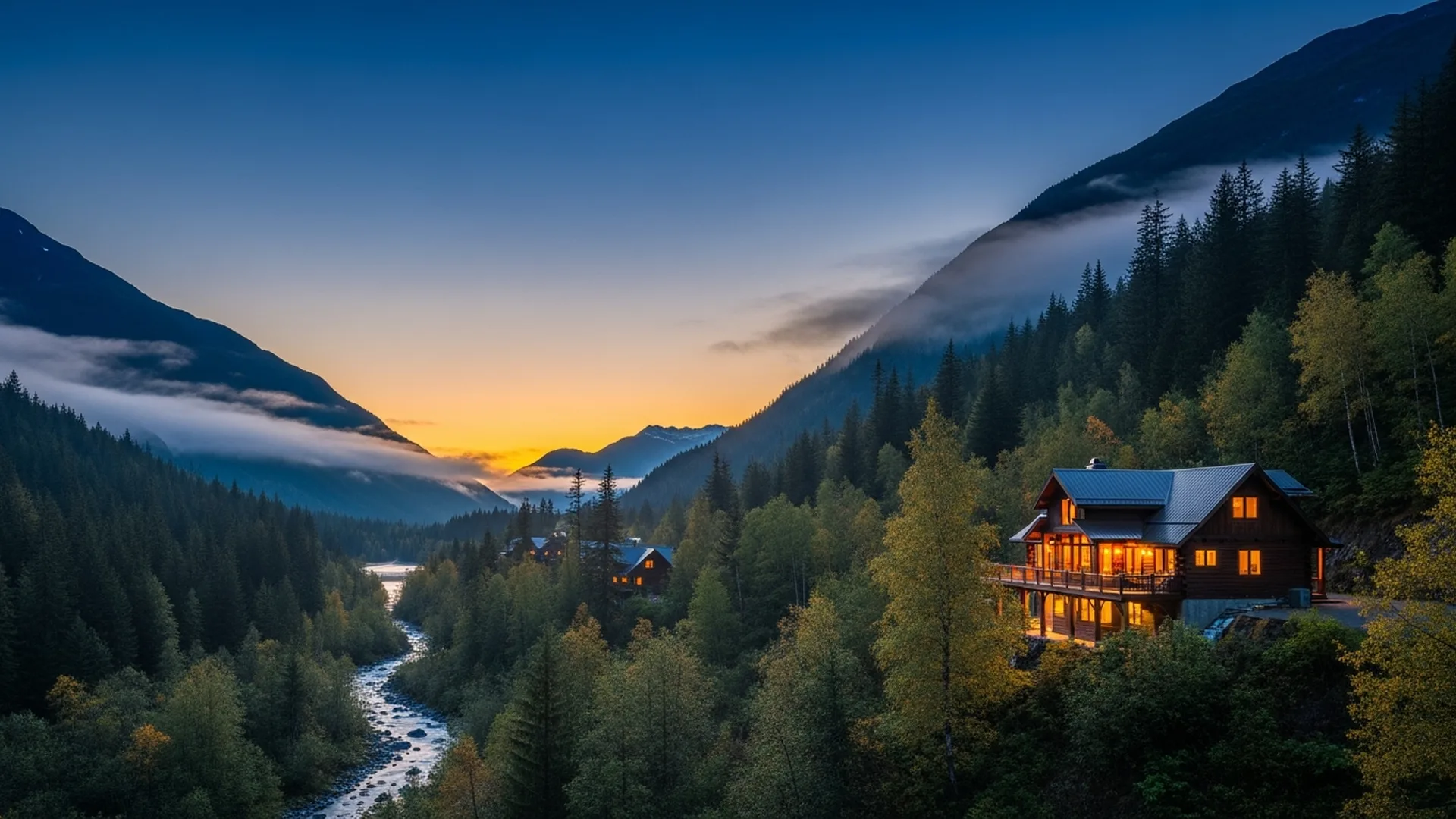
Crow Creek is a valley enclave in Girdwood, Alaska, reached by Crow Creek Road, which turns off the Alyeska Highway about two miles up from the Seward Highway — roughly 35 to 40 miles southeast of downtown Anchorage in the Chugach Mountains. Homes range from historic gold-rush-era cabins to modern chalets and large private acreage parcels, and many sit on well and septic rather than city utilities, so parcel-by-parcel due diligence matters. The lower road is paved and maintained while the upper gravel section toward the historic Crow Creek Mine and Crow Pass trailhead is unmaintained in winter. Because Girdwood functions as a resort community, a large share of homes are owned as second homes or used as short-term rentals under Municipality of Anchorage rules.
I’ve driven up Crow Creek Road in every season Anchorage has to offer, and it’s one of the few addresses in the whole Girdwood valley where you can feel the town’s gold-rush origins still underfoot. Girdwood began life as Glacier City, a supply camp for placer miners working claims on Crow Creek and neighboring drainages after gold was found here in 1896; the community even takes its name from Colonel James Girdwood, an Irish immigrant who staked four claims on Crow Creek. That history isn’t a museum piece — the historic Crow Creek Mine at the top of the road is still a working, family-run operation and one of the oldest sites in the Municipality of Anchorage.
For a buyer, that heritage translates into a very particular kind of property: a mix of older cabins, off-grid parcels, and newer homes set on generous, wooded lots along a road that starts paved near the valley floor and climbs to gravel as it heads into the mountains. This guide walks through what actually matters here — location and access, utilities, winter and snow-load realities, and how the second-home market shapes value — grounded in current Municipality of Anchorage and Alaska sources rather than generic advice.
- Crow Creek Road turns off the Alyeska Highway about two miles up from the Seward Highway; Girdwood is roughly 35–40 miles southeast of downtown Anchorage in the Chugach Mountains at the head of Turnagain Arm.
- The lower residential stretch of Crow Creek Road is paved and maintained; the upper gravel section toward the mine and Crow Pass trailhead is described as unmaintained roughly October–May, with the state regrading it around June 1.
- Utilities vary by parcel — Girdwood has its own AWWU wastewater plant serving the sewered core, but many Crow Creek lots use private well and septic, and some older parcels are off-grid with no utilities.
- In the Municipality of Anchorage, a new well or new/upgraded septic system requires a permit through the On-Site Water and Wastewater Section, with a septic design by a registered civil engineer.
- Girdwood is a resort market: a 2024 economic and housing analysis found about 47% primary-resident ownership, 42% Alaska-based second-home owners, and 11% out-of-state owners.
- Short-term rentals are allowed under Anchorage rules but carry a 12% room tax and a free registration requirement effective May 2026; only registered rentals may be listed on platforms.
- Girdwood sits in avalanche-prone Chugach terrain with heavy snowfall, so snow load, roof design, drainage, and lot position relative to slopes are essential checks.
Where exactly is Crow Creek in Girdwood, and how do you get there?
Girdwood lies in a glacially carved valley in the Chugach Mountains near the end of Turnagain Arm, a narrow branch of Cook Inlet, and the whole community is part of the Municipality of Anchorage even though it sits about 35 to 40 miles down the Seward Highway. To reach Crow Creek, you turn off the Seward Highway onto the Alyeska Highway near the gas station at roughly Mile 90, drive about two miles, then turn onto Crow Creek Road.
From there the road tells a story of two halves. The lower portion is paved, developed, and lined with homes; higher up, it becomes the narrow, winding gravel road that leads to the historic Crow Creek Mine (about three miles up from New Town Girdwood) and eventually dead-ends near the Crow Creek trailhead, the Girdwood-side start of the 21-plus-mile Crow Pass Trail on the Iditarod National Historic Trail. Unlike a resort-base condo, a Crow Creek home puts you in a wooded valley setting with trailheads and Crow Creek itself close at hand — but it also means access details shift dramatically depending on exactly how far up the road a property sits.
| Segment | Surface & maintenance | What’s there |
|---|---|---|
| Alyeska Hwy off Seward Hwy | Paved, state-maintained | Resort base, downtown Girdwood, services |
| Lower Crow Creek Rd | Paved, maintained | Residential lots & homes |
| Upper Crow Creek Rd (~3 mi+) | Gravel; unmaintained ~Oct–May, regraded ~June 1 | Historic Crow Creek Mine |
| Road end (~5–7 mi) | Narrow, winding gravel | Crow Creek / Crow Pass trailhead |
What kind of homes are on Crow Creek Road?
This is not a subdivision of look-alike houses. Crow Creek and the surrounding valley carry a genuinely eclectic housing stock — older townsite cabins, resort-adjacent chalets, larger custom homes, and some raw acreage. You’ll find everything from off-grid parcels with independent cabins and no well, septic, or utilities, to substantial wooded lots of an acre or more, up to some of the largest remaining private development parcels in the valley. Because Girdwood is land-constrained by mountains and public land, a private acreage lot with real elbow room is a scarce commodity here in a way it simply isn’t in the Anchorage Bowl.
Buyers who tour Girdwood consistently discover that price ranges widely by condition, utilities, and exactly where a property sits. Reporting in late 2025 put the average Girdwood home value nearing $700,000 and up sharply year over year, and Timberline Drive homes elsewhere in the valley have been assessed near $1 million — but on Crow Creek specifically, a rustic cabin and a finished chalet on acreage are two very different purchases. I always tell buyers to price the property by what it is and what it’s connected to, not by the valley average.
Do Crow Creek homes have city water and sewer, or well and septic?
It depends entirely on the parcel, and this is the single check I won’t let a buyer skip. Girdwood is served by its own Anchorage Water & Wastewater Utility (AWWU) treatment facility — a modern tertiary plant with roughly 600,000 gallons per day of capacity that discharges near-drinking-water-quality effluent to Glacier Creek — and there’s also a Girdwood well field supplying public water. But that sewered, public-water core doesn’t reach every lot. Plenty of Crow Creek properties, especially older ones and those farther up, run on a private well and septic system, and some off-grid cabins have neither.
Where a home is on private systems, the Municipality of Anchorage rules are specific: a new well or a new or upgraded septic system requires a permit through the On-Site Water and Wastewater Section, and a septic design with soils and site information must be submitted by a registered civil engineer. If code-required separation distances between well and septic can’t be met, a home may be eligible for a separation-distance waiver, decided case by case. The well-and-septic surprise that catches Girdwood buyers most often isn’t the system itself — it’s assuming “it’s in town, so it must be on city services.” Verify the actual water and wastewater setup, and its permit history, before you write an offer.
Two Crow Creek lots that look identical on a map can carry very different utility realities — one on public water and sewer, the next on a private well and engineered septic. That difference shows up in ownership cost, in what you can build, and in your inspection checklist, so treat it as a first-order question, not a closing-day detail.
What are the winter, avalanche, and snow-load realities here?
Girdwood is a maritime mountain valley, and the numbers behind that setting are real. It draws abundant, moisture-heavy precipitation year-round, with well over 200 inches of snow annually at higher elevations, and its terrain is steep and glacially oversteepened, with slopes frequently exceeding 30 degrees. The valley sits in the avalanche-prone Chugach, and municipal planning documents specifically note avalanche hazard in the area; the Seward Highway corridor near Girdwood has been managed for avalanche risk for decades, with the state DOT&PF using forecasting and explosive mitigation and a January 2025 federal grant funding advanced detection along the highway.
For a home purchase, that translates into concrete engineering questions. A structural engineer should confirm the roof and framing are designed for the local snow load, and you should understand where the lot sits relative to slopes and potential avalanche runout. Practical winter items — snow storage, roof-shed direction, drainage, driveway grade, and emergency access — separate a home that’s a joy in January from one that’s a headache. This is exactly where the design-eye side of my background earns its keep: I read how a house is built to shed and store snow, not just how it photographs.
What draws buyers to Crow Creek
- Quiet valley setting minutes from Alyeska Resort and trailheads
- Larger, wooded and acreage lots that are scarce elsewhere near Anchorage
- Authentic gold-rush heritage and the historic Crow Creek Mine at the road’s top
- Strong resort demand supporting second-home and rental use
What to verify before buying
- Exact water & wastewater setup (public vs. well/septic vs. off-grid) and permits
- Where winter road maintenance ends relative to the property
- Snow-load engineering, drainage, and lot position vs. slopes
- Current zoning, allowed uses, and any short-term-rental rules for your plan
How does Girdwood’s second-home and rental market shape a Crow Creek purchase?
Girdwood behaves more like a resort community than a conventional neighborhood, and the ownership data proves it. A 2024 Girdwood economic and housing analysis found that about 42% of housing units are owned by Alaskans living outside Girdwood, 11% by owners living outside Alaska, and 47% by primary residents — a large share of second-home and recreational ownership. The Girdwood Board of Supervisors has stated the community is far more heavily affected by vacation rentals than the rest of the Municipality, with roughly a quarter of homes used as vacation rentals versus about 1% elsewhere in Anchorage.
If you’re considering rental use, know the current rules. Rentals under 30 days are subject to Anchorage’s 12% room tax, and the Municipality adopted a free short-term-rental registration requirement that took effect in May 2026, with a grace period to register and a rule that only registered rentals may be listed on platforms like Airbnb and Vrbo. Anchorage voted down a proposed additional 5% vacation-rental tax in December 2025, so the 12% room tax remains the operative lodging levy for now. The practical takeaway I give every buyer: don’t assume a Crow Creek home will work as a rental just because similar homes appear to be rented — verify current zoning, allowed uses, parcel-specific restrictions, and registration for your intended use from the start.
Thinking of selling on Crow Creek? What drives value here
Selling in Girdwood is as much about telling the property’s truth well as it is about price. On Crow Creek, the value levers I watch are utility status (a clean, permitted well and septic or public-service connection removes a major buyer worry), documented winter access, snow-load and structural documentation, and how genuinely usable the lot is across all four seasons. Because so many buyers here are Alaska-based or out-of-state second-home purchasers, presentation and honest, complete disclosure carry real weight — a buyer flying in for one weekend decides fast, and the homes that show their year-round livability win.
My background in design and furnishings means I stage and present a mountain home to read as calm, warm, and built for the climate rather than merely rustic — the difference that moves the final number. If you own on Crow Creek Road, I can walk your specific parcel’s value drivers and prepare a current, custom valuation. When you’re ready, get your Girdwood-area home value.
- Municipality of Anchorage, Office of Community Planning & Development — Wells & Septic Systems (On-Site Water and Wastewater Section permit requirements).
- Municipality of Anchorage, Title 21 Chapter 21.09 — Girdwood Land Use Regulations and zoning districts (incl. GCR-3 Crow Creek Historic Mine).
- Anchorage Water & Wastewater Utility (AWWU) — Girdwood well field and Girdwood Wastewater Treatment Facility capacity and discharge.
- Anchorage Daily News & Alaska Public Media (Dec 2025–May 2026) — short-term-rental registration ordinance, 12% room tax, and Girdwood vacation-rental share.
- 2024 Girdwood Economic and Housing Analysis (via Calling Alaska Home summary) — owner-occupancy and second-home ownership breakdown.
- Chugach National Forest / Alaska DNR / Alaska.org — Crow Creek Road access, Crow Creek Mine, and Crow Pass Trail directions and distances.
- Grokipedia / NOAA-referenced climate and terrain data — Girdwood geography, snowfall, oversteepened slopes, and avalanche history including the Crow Creek area.
- Alaska DOT&PF — Seward Highway avalanche mitigation near Girdwood.
Considering a Crow Creek home in Girdwood?
Work with a 40-year Anchorage local who reads the winter details, not just the view.
Frequently Asked Questions
Crow Creek is a valley enclave reached by Crow Creek Road, which turns off the Alyeska Highway about two miles up from the Seward Highway in Girdwood. Girdwood itself sits roughly 35 to 40 miles southeast of downtown Anchorage in the Chugach Mountains at the head of Turnagain Arm, and is part of the Municipality of Anchorage. Homes lie along the lower, paved and maintained stretch of the road before it turns to gravel and climbs toward the historic Crow Creek Mine and the Crow Pass trailhead.
It varies by parcel and you must verify each one. Girdwood has its own AWWU wastewater treatment facility that serves the sewered core of the valley, but many lots along Crow Creek Road — especially older cabins and off-grid parcels — rely on a private well and septic system, and some have no utilities at all. In the Municipality of Anchorage, a new well or new or upgraded septic system requires a permit through the On-Site Water and Wastewater Section, with a septic design prepared by a registered civil engineer.
The lower residential stretch of Crow Creek Road is paved and maintained, but the upper gravel section toward the Crow Creek Mine and trailhead is described by the mine as bumpy and unmaintained roughly between October and May, with the state grading it around June 1 each year. Confirm exactly where a specific home sits relative to the maintained portion and who is responsible for plowing before you buy, because a home that is easy to reach in summer can be very different in deep winter.
Girdwood functions as a resort and recreation community rather than a typical primary-home market. A 2024 Girdwood economic and housing analysis found that about 42% of housing units are owned by Alaskans living outside Girdwood, 11% by people living outside Alaska, and 47% by primary residents. The Girdwood Board of Supervisors has stated that roughly a quarter of the community's homes are vacation rentals, compared with about 1% in the rest of Anchorage.
Short-term rentals are allowed in Girdwood under Municipality of Anchorage rules, but there are requirements. Rentals under 30 days are subject to Anchorage's 12% room tax, and the Municipality adopted a free short-term rental registration requirement that took effect in May 2026, with only registered rentals eligible to be listed on platforms like Airbnb and Vrbo. Always verify current zoning, allowed uses, and parcel-specific restrictions before assuming a home can be used as a rental.
Girdwood sits in the avalanche-prone Chugach Mountains with steep, glacially oversteepened terrain and very heavy snowfall, and municipal planning documents note avalanche hazard in the valley. A structural engineer should confirm the roof and framing are designed for the local snow load, and you should look at where a lot sits relative to slopes and runout paths. Buyers focused on the view often overlook the winter reality — roof loads, snow storage, drainage, and emergency access all matter here.
Crow Creek Road is within a few miles of the Alyeska Resort base and downtown Girdwood — the Crow Creek Mine describes itself as about three miles up the road from New Town Girdwood. That puts these homes close to the ski area and the Winner Creek and Crow Pass trail systems while sitting in a quieter valley setting rather than at the resort base itself.